
Job losses in the United States have accelerated sharply in 2025, painting a sobering picture of a labour market under pressure from policy shifts, economic uncertainty, and corporate restructuring. Contrary to widespread public belief, artificial intelligence is not the primary force behind the layoffs, according to newly released data.
Year-to-date figures compiled by Challenger, Gray & Christmas and visualised by Visual Capitalist reveal that government-linked policy actions and broader macroeconomic stress are the dominant drivers of job cuts this year—far outweighing technology-led disruption.
Policy-Driven Layoffs Lead the Tally
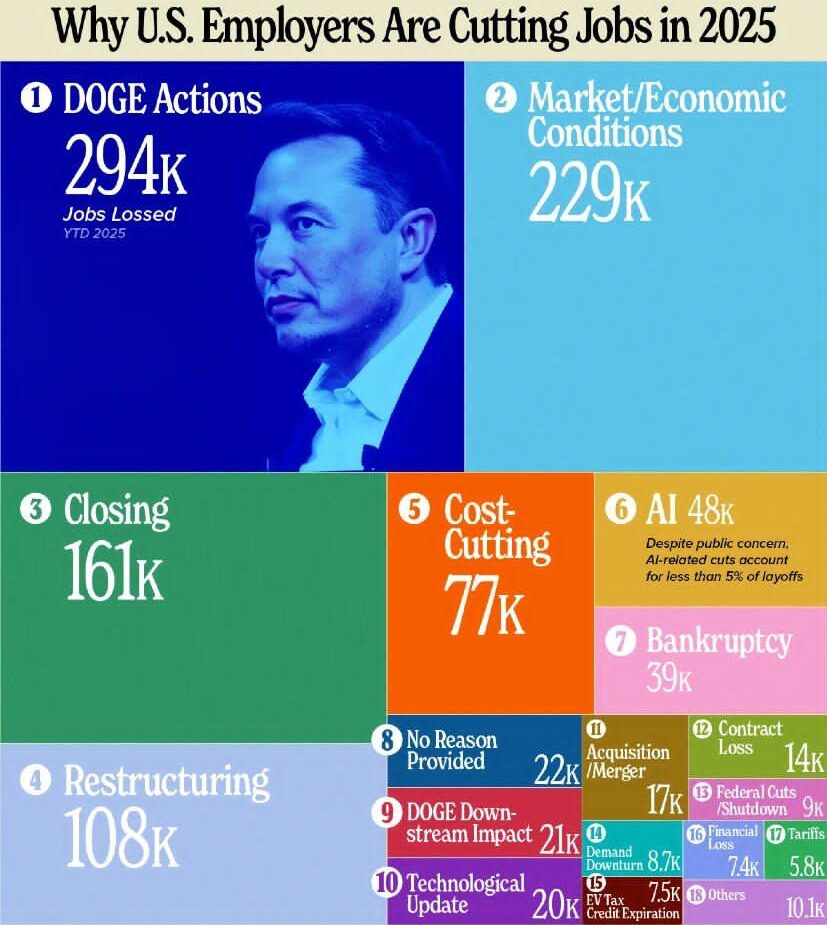
The single largest contributor to job losses in 2025 has been policy-driven actions linked to DOGE-related reforms, which have resulted in nearly 294,000 layoffs so far. These cuts stem from sweeping changes in funding priorities, regulatory rollbacks, and budget realignments that have directly affected federal agencies, contractors, and dependent industries.
Experts note that while policy reforms are often intended to improve efficiency, the immediate impact on employment can be severe, especially for sectors reliant on government spending and long-term public contracts.
Economic Pressures Hit Businesses Hard
Close behind policy actions are market and economic conditions, responsible for approximately 229,000 job losses. Companies across industries are grappling with slower demand, elevated interest rates, inflationary pressures, and cautious consumer spending, forcing many firms to scale back operations.
Additionally, business closures have led to another 161,000 layoffs, particularly affecting retail, logistics, and small-to-mid-sized enterprises struggling to remain viable in a challenging environment.
Corporate restructuring efforts have also played a major role, eliminating nearly 108,000 jobs as firms reorganise, consolidate departments, and focus on profitability rather than expansion.
AI Not the Villain—At Least Not Yet
Despite growing fears about automation, AI-related job cuts account for only about 48,000 positions, representing less than 5% of total layoffs in 2025. Analysts say this figure highlights a significant disconnect between public perception and reality.
“AI is reshaping jobs, but it is not the mass job destroyer many assume it to be—at least for now,” economists note. Instead, uncertainty around policy, costs, and demand is proving far more disruptive.
Other Factors Adding to Job Losses
Additional contributors include cost-cutting initiatives (77,000 jobs), bankruptcies (39,000), mergers and acquisitions (17,000), as well as layoffs linked to contract losses, tariff-related pressures, and federal shutdown effects.
What Lies Ahead
Labour market experts warn that while some stabilisation may occur later in the year, continued economic volatility and policy unpredictability could keep employment under strain. For workers, the data sends a clear message: adaptability, upskilling, and awareness of broader economic forces—not just AI—are critical to navigating the evolving job market.
As 2025 unfolds, the real threat to jobs appears less technological and more structural—rooted in decisions made far beyond the office floor.