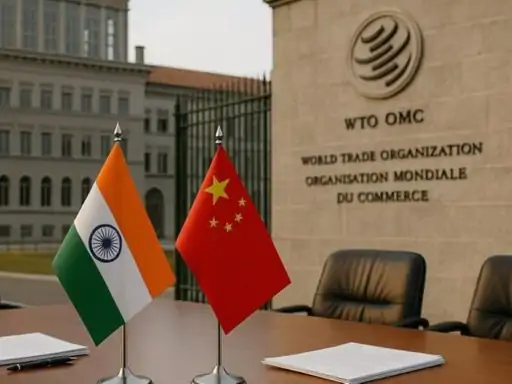
Trade frictions between Asia’s two largest economies have escalated after China formally approached the World Trade Organization (WTO) against India, challenging New Delhi’s import duties on IT products and the Production-Linked Incentive (PLI) scheme for solar PV modules.
China has requested formal dispute consultations, the first step under the WTO’s dispute settlement mechanism, signalling a new phase of strain in India–China trade relations.
China Flags IT Import Duties as WTO Violation
In its complaint, Beijing alleges that India has imposed customs duties on certain information technology products that exceed the tariff limits committed under WTO agreements, including the Information Technology Agreement (ITA).
The disputed items reportedly include:
◆Semiconductor devices
◆Mobile and wireless communication equipment
◆Machinery used in semiconductor manufacturing
◆Other advanced IT and electronic products
China argues that higher tariffs on these products violate India’s multilateral trade commitments and disadvantage Chinese exporters, while also disrupting global electronics supply chains.
Solar PLI Scheme Under WTO Scanner
Alongside IT tariffs, China has also challenged India’s Solar PV PLI scheme, claiming it contains local content and domestic sourcing requirements that discriminate against imported products.
According to Beijing, these provisions unfairly favour Indian manufacturers and may amount to prohibited subsidies under the WTO’s Subsidies and Countervailing Measures (SCM) Agreement.
India launched the Solar PLI scheme in 2021 to boost domestic manufacturing, cut import dependence—particularly on China—and strengthen energy security while meeting renewable energy targets.
What Happens Next at the WTO
The WTO Secretariat confirmed that China’s request for consultations has been circulated to member nations. If consultations fail to resolve the dispute within the stipulated period, China can seek the formation of a dispute settlement panel.
However, experts caution that the WTO’s dispute mechanism is currently facing structural challenges, including a non-functional appellate body, which could delay final resolution.
Trade Context: A Growing Imbalance
China remains India’s largest import source and second-largest trading partner. Between April and October FY 2025–26, India exported goods worth about $10 billion to China, while imports surged to nearly $74 billion, deepening India’s trade deficit.
Analysts note that India’s tariff and incentive policies in sectors like electronics and renewable energy are part of a broader industrial strategy to strengthen domestic manufacturing and reduce strategic dependence.
Why This Dispute Matters
Trade experts believe the case goes beyond legal technicalities. If it proceeds to a WTO panel, it could shape the global debate on industrial policy, subsidies, and development strategies, especially for emerging economies balancing free trade rules with domestic growth priorities.
For now, attention is focused on India’s official response and whether the dispute can be resolved during consultations—or turns into a full-blown WTO trade battle.