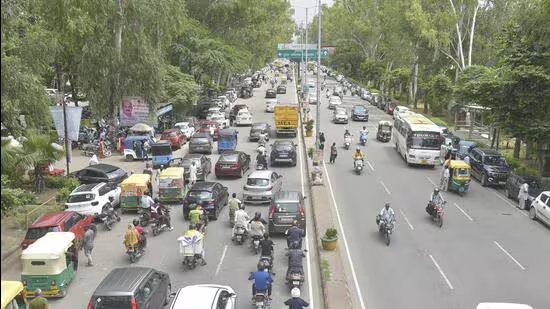
In an effort to tackle increasing traffic congestion, the Ghaziabad Development Authority has identified 10 major junctions and road intersections across Ghaziabad for a major infrastructure revamp.
The authority also plans to engage Rail India Technical and Economic Service to prepare a comprehensive mobility plan aimed at improving traffic movement across the city.
Officials said the initiative is designed to reduce daily traffic snarls and improve travel time in some of Ghaziabad’s busiest areas.
Elevated Road Planned at Hapur Chungi
One of the most important projects under the plan is the redevelopment of the Hapur Chungi Roundabout, a major traffic convergence point in the city.
Traffic from Kavinagar, Rajnagar Extension, the DM office, and the police line currently merges at this junction, often causing heavy congestion.
To address this issue, authorities are planning to construct a 1.5-kilometre elevated road connecting Rajnagar Extension to Kavinagar and Shastri Nagar, bypassing the Hapur Chungi intersection.
The four-lane elevated corridor, estimated to cost around Rs 10 crore, will be funded through GDA’s infrastructure fund.
Ten Key Traffic Points Identified for Revamp
Apart from Hapur Chungi, the development authority has identified several other busy junctions where infrastructure improvements will be carried out.
These include:
●DPS cross-section to Leelawati cross-section
●Madhuban Bapudham Roundabout
●Bunkar Mart Chowk
●River Heights Roundabout
●Holy Child Roundabout
●Hint Chowk
●Ajnara Roundabout
●Seth Mukundlal Roundabout
Officials said redesigning these intersections will help streamline vehicle movement and reduce delays during peak traffic hours.
Severe Congestion Highlighted in Earlier Study
A previous traffic study conducted by the Central Road Research Institute had already highlighted serious congestion issues in the city.
According to the report, the Modinagar–Muradnagar road corridor handles around 1.3 lakh vehicles every day, making it one of the busiest routes connecting Meerut and Dehradun.
The study also revealed that average vehicle speeds on the stretch remain between 38–42 km/h, significantly lower than the ideal operating speed of 56–76 km/h, indicating heavy traffic pressure.
Long-Term Plan to Improve City Mobility
Officials said the new mobility plan will help authorities identify long-term infrastructure solutions such as flyovers, road widening, and improved intersection designs.
The project aims to make Ghaziabad’s road network more efficient and reduce travel time for daily commuters across the rapidly growing NCR city.