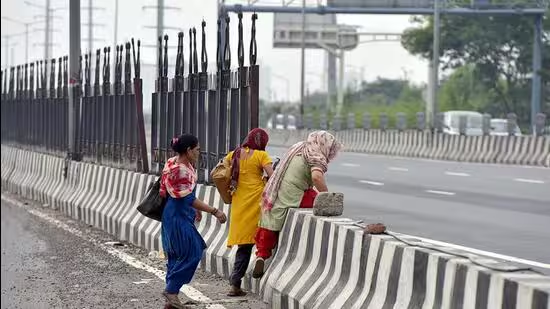
For hundreds of workers in Gurgaon, reaching the workplace is no longer just a routine—it has become a life-threatening challenge.
Along a busy stretch of NH8 near the Binola Industrial Area, over 700 people every hour are forced to cross a high-speed highway without any pedestrian safety infrastructure. What should have been a basic civic necessity—a foot overbridge—remains incomplete, turning daily commutes into dangerous sprints across fast-moving traffic.
From factory workers to delivery staff and daily wage earners, every crossing is a calculated risk. For some, it has already proved fatal.
A Blackspot Marked by Tragedy
The numbers paint a grim picture. Between 2024 and 2025, at least 21 accidents have been reported at this very stretch. Fourteen people lost their lives, including eight pedestrians.
Many of them were not reckless drivers or violators—they were simply individuals trying to cross the road to reach work or return home.
Locals say the danger is constant and unavoidable. With no safe crossing option, pedestrians are left with only one choice: wait, judge the speed of oncoming vehicles, and run.
The Missing Bridge That Could Save Lives
A foot overbridge (FOB) at Binola was proposed by the National Highways Authority of India as part of a larger Rs 282 crore project to build nine pedestrian bridges along a 59-km stretch.
While construction began, progress slowed significantly due to objections raised by a nearby landowner. The dispute over location has left the structure incomplete, even as pedestrian movement continues to rise.
Officials now say the bridge may be completed by the end of April, but for those crossing daily, every delay comes with real consequences.
Ground Reality: Chaos, Speed, and No Safe Passage
The situation on the ground is far more dangerous than it appears on paper.
Open drains between service roads and the highway force pedestrians to climb over obstacles before even reaching traffic. Public transport stops directly on the highway, with buses and autos dropping off passengers who then have no option but to cross immediately.
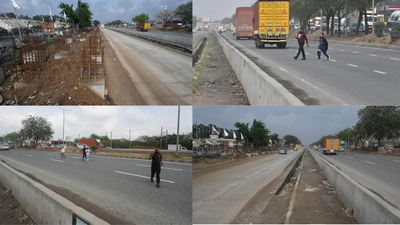
During peak hours, hundreds gather at the roadside, waiting for a brief gap in traffic. What follows is a desperate dash across multiple lanes, often with bags, children, or heavy loads in hand.
Encroachments, parked vehicles, and narrow service roads further reduce safe space, making the crossing even more chaotic.
“We Just Hope to Make It Across”
For locals, the fear is constant and deeply personal. Many have witnessed accidents firsthand.
Stories of sudden deaths, near misses, and daily anxiety are common in the area. Workers say they have no alternative route, no signals, and no protection—only timing and luck.
Even those who cross safely every day admit that each attempt feels uncertain.
What Experts Have Found
A recent audit by traffic authorities confirmed what locals already know:
the current crossing point is both necessary and heavily used.
The report highlighted multiple risks—unregulated pedestrian movement, lack of infrastructure, unsafe boarding points, and high-speed traffic flow.
It also recommended urgent solutions, including:
●Immediate completion of the footbridge
●Covering of open drains
●Shifting public transport stops
●Strict action against encroachments
But until these measures are implemented, the danger remains.
A Crisis Hidden in Plain Sight
This is not just a traffic issue—it is a planning failure affecting hundreds of lives every day.
The irony is stark: while infrastructure projects worth crores are underway, basic pedestrian safety remains incomplete.
Every morning and evening, the same scene repeats itself—people gathering at the edge of a roaring highway, waiting for a chance to cross.
And then they run.
The Urgency Cannot Wait
With over 700 pedestrians crossing every hour, this stretch of NH8 has effectively become a daily risk zone.
Until the footbridge is completed and proper safety measures are implemented, the question remains:
◆ How many more lives will it take before safe infrastructure is treated as a priority, not a delay?