
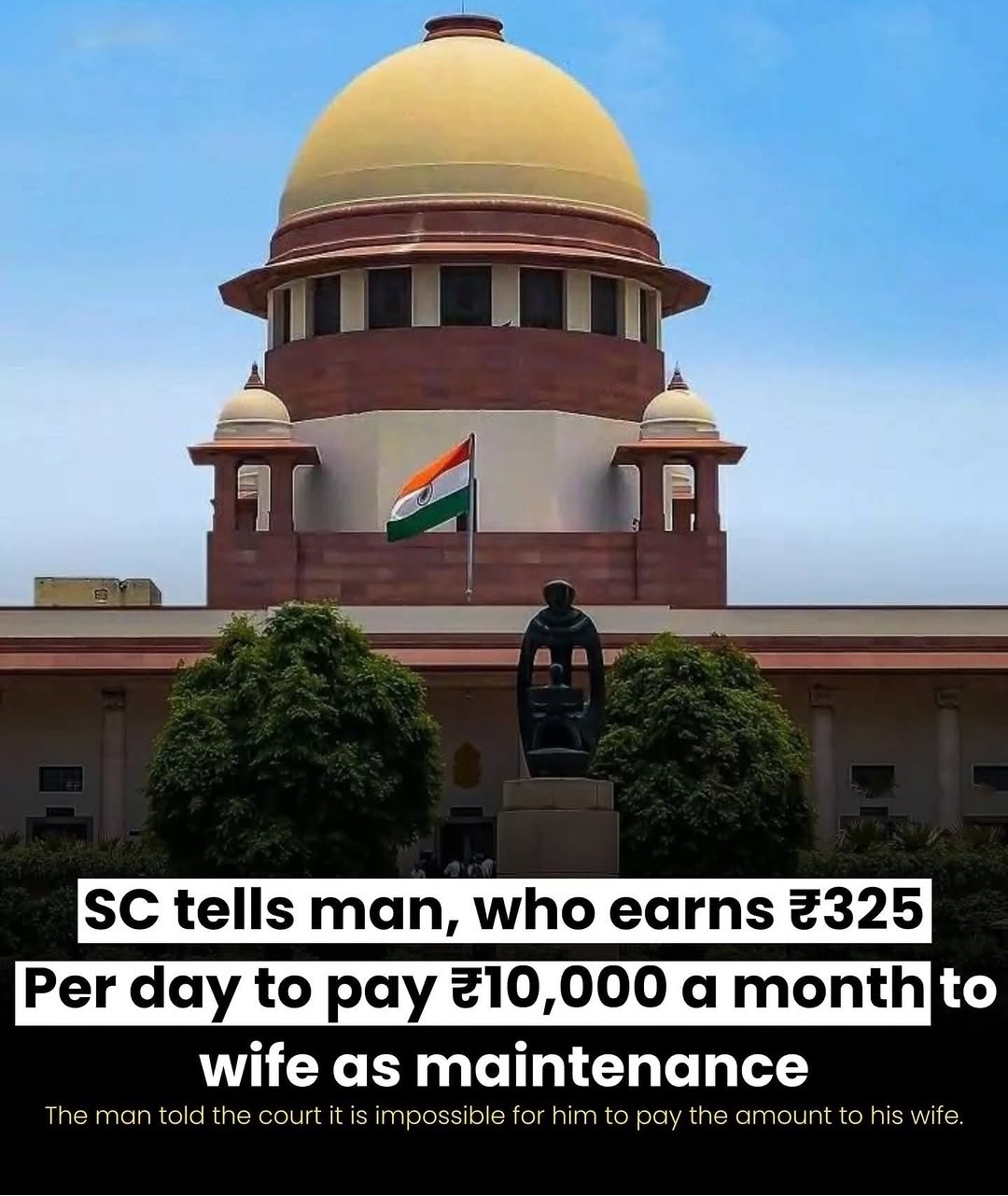
In a significant ruling reinforcing the principle of financial responsibility within marriage, the Supreme Court of India has directed a man—who claimed to earn only Rs 325 per day—to pay Rs 10,000 per month as maintenance to his estranged wife. The decision has sparked widespread discussion on social media and legal circles, highlighting the court’s firm stance against attempts to understate income to avoid spousal support.
The Case: Income Claim vs Reality
The case revolved around a husband who argued before the court that his limited daily earnings made it impossible for him to pay substantial maintenance. According to his claim, he earned approximately ₹325 per day, translating to a modest monthly income.
However, the court was not convinced.
After examining the circumstances, the bench observed that such claims often do not reflect the complete financial reality of an individual. Courts have repeatedly noted that many individuals tend to underreport or misrepresent income to reduce maintenance obligations.
The Supreme Court made it clear that mere claims of low income cannot be accepted at face value, especially when the responsibility towards a dependent spouse is involved.
Court’s Stand: Duty Cannot Be Avoided
The apex court emphasized that a husband has a legal and moral obligation to ensure that his wife is not left without financial support. Maintenance, the court said, is not a charity—it is a right.
The judges highlighted that:
●A woman should be able to live with dignity, even after separation
●Financial dependency cannot be used as a tool for neglect
●Courts must ensure fair and realistic assessment of earning capacity, not just declared income
By ordering Rs 10,000 per month, the court reinforced that earning capacity matters more than stated income.
Why This Judgment Matters
This ruling goes beyond a single case—it sets a broader precedent.
Across India, maintenance disputes often involve conflicts over income disclosure. Many cases see one party attempting to minimize reported earnings to reduce financial liability. This judgment sends a clear signal that such tactics will not easily succeed.
The decision also strengthens the position of women seeking maintenance, ensuring that they are not pushed into financial hardship due to technical or misleading arguments.
Balancing Rights and Responsibilities
Legal experts believe the judgment strikes a balance between fairness and accountability. While courts are mindful of genuine financial limitations, they also recognize that responsibility towards a spouse cannot be evaded through incomplete disclosures.
The ruling reflects a consistent judicial approach—ensuring that separation does not translate into economic abandonment.
The Larger Social Context
In a country where many women still rely financially on their spouses, maintenance laws act as a critical safety net. This case highlights the importance of those protections in real-life scenarios.
It also raises an important question:
Should income verification mechanisms be strengthened further to ensure transparency in such disputes?
The Supreme Court’s decision is a reminder that accountability in relationships extends beyond emotional commitments—it includes financial responsibility as well.
By rejecting the Rs 325-per-day claim and enforcing a Rs 10,000 monthly payment, the court has reinforced a powerful principle:
Justice must reflect reality, not just claims.