

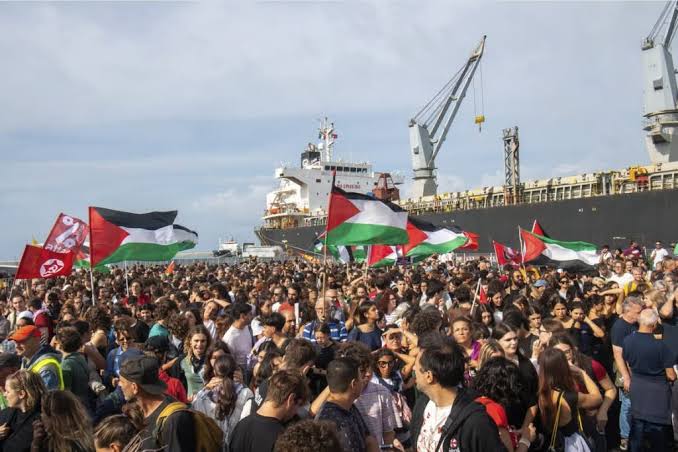
PARIS Dockworkers across 113 ports in 22 countries staged a collective strike on Friday to demonstrate against the transfer of weapons to conflict zones. The international action, organized under the campaign name ‘Port for Peace, Job with Dignity’, brought maritime operations to a standstill as trade unions insisted that commercial terminals must not be utilized to ship weapons, ammunition, and military equipment intended for armed conflict and mass violence. Union representatives emphasized that dockworkers handle commercial trade and do not work to support warfare.
Supply Lines to the Middle East Targeted
The primary objective of the synchronized walkout was to halt arms shipments feeding into the ongoing conflicts in Gaza and the wider Middle East. Trade unions asserted that commercial shipping infrastructure should never serve as a conduit for war materiel. Labor groups maintained that employees working on the docks have every right to refuse participation in the logistics of military violence, urging shipping authorities to maintain commercial hubs strictly for civilian and economic purposes rather than active conflict.
Key European Hubs Impacted by the Action
The coordinated work stoppage disrupted operations at some of Europe’s largest maritime freight centers. Key locations hit by the strike included Genoa in Italy, Le Havre and Marseille in France, Piraeus in Greece, and Hamburg in Germany. In Piraeus, the action was accompanied by an anti-war rally during a 24-hour strike held by Greek sailors, where demonstrators marched through the terminal area raising slogans against military shipments and protesting the involvement of civilian infrastructure in geopolitical conflicts.
Broader Demands for Labor Protections and Wages
While anti-war opposition formed the core of the walkout, participating dockworkers also used the collective demonstration to challenge domestic workplace policies. Employees voiced strong opposition against ongoing port privatization efforts, calling instead for higher wages, safer working environments, permanent job contracts, and comprehensive collective labor agreements. The initiative was originally coordinated by dockworkers’ unions representing Italy, France, Greece, Spain’s Basque region, Turkiye, and Morocco, and it quickly expanded to receive the backing of more than 25 unions globally.

