
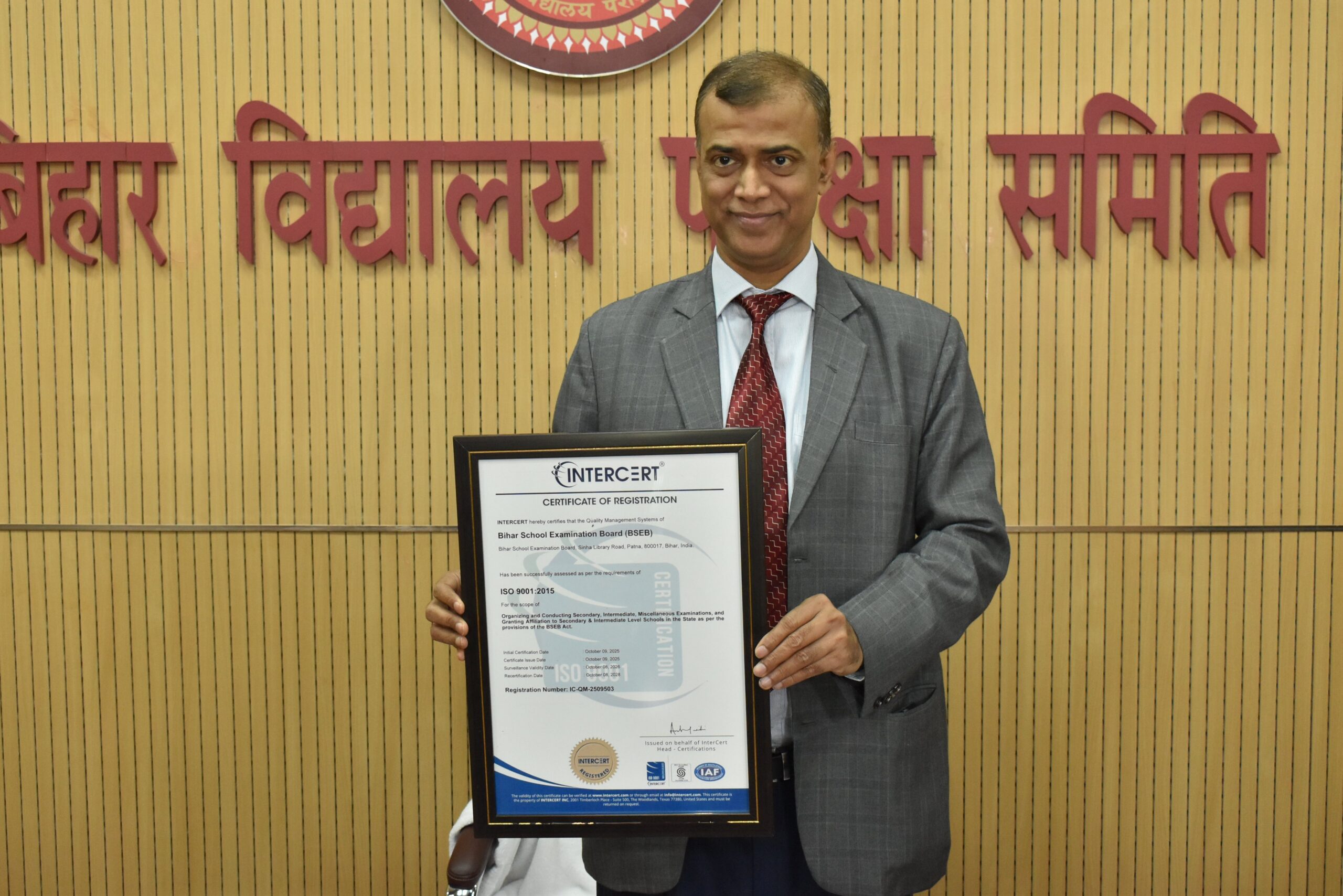
In a stunning turnaround that rewrites its own past, the Bihar School Examination Board (BSEB) has achieved what no other education board in India has done before. Once associated with controversies and examination irregularities, the Bihar Board has now emerged as a national benchmark in transparency, technology, and governance by securing three prestigious international ISO certifications simultaneously.
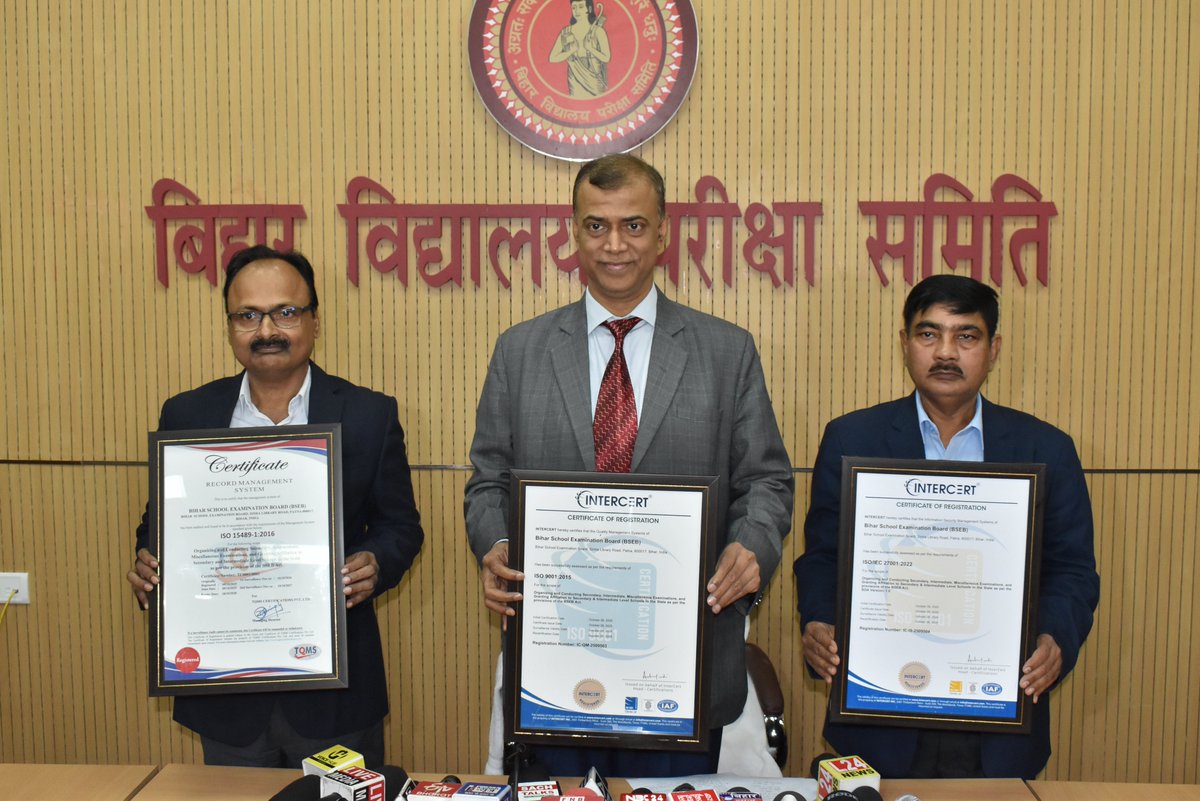
With this achievement, BSEB becomes India’s first education board to receive ISO 9001:2015, ISO/IEC 27001:2022, and ISO 15489-1:2016 certifications together — a milestone that reflects global standards in quality management, information security, and record management.
A Rare Triple Certification Achievement
The three ISO certifications recognise excellence in critical operational areas:
◆ISO 9001:2015 — Quality Management System
◆ISO/IEC 27001:2022 — Information Security Management System
◆ISO 15489-1:2016 — Records Management System
While even national boards like CBSE currently hold only two ISO certifications, Bihar Board has gone a step ahead by earning all three — placing it in a league of its own within India’s education ecosystem.
This recognition confirms that BSEB not only conducts examinations efficiently but also protects student data, preserves academic records, and follows globally accepted administrative practices.
From Crisis to Credibility: Digital Reforms at the Core
According to Anand Kishor, Chairman of BSEB, the transformation is the result of sustained digital and administrative reforms implemented over the past several years.
“The entire examination ecosystem has been rebuilt using advanced IT tools. From registration to evaluation and result declaration, every step is now technology-driven, transparent, and secure,” Kishor said.
Key reforms include:
●Online registration and fee payment
●Digital admit cards
●Automated evaluation and result processing
●Pre-exam and post-exam software systems
These changes have drastically reduced human intervention, virtually eliminating malpractice and delays.
India’s Fastest Result-Releasing Board
For seven consecutive years, the Bihar Board has been the first in the country to announce Class 10 and Class 12 results — a record unmatched by any other board.
This efficiency is powered by a fully digitised archival system. Examination records dating back to 1983 through 2025 have been digitally preserved, enabling instant verification and seamless access for students and institutions alike.
E-Office, ERP, and Paperless Governance
BSEB has replaced traditional paper-based file systems with a comprehensive E-Office and ERP framework. Every administrative process — file movement, approvals, and decision-making — is now digitally tracked in real time.
This has brought:
●Faster decision-making
●Greater accountability
●Complete transparency in administration
The shift has fundamentally changed how the board functions internally.
High-Security Data Centre and Student-Friendly Systems
A state-of-the-art data centre with 200 TB storage capacity now securely houses all student and examination data. Meanwhile, the Online Facilitation System for Students (OFSS) has processed over 9.6 million college admission applications since 2018.
The platform has eliminated middlemen, making admissions:
●Fully online
●Transparent
●Paperless
Students can apply, track status, and secure admission through a single digital window.
A Model Other States Want to Follow
BSEB’s success has drawn attention from education departments across India. Officials from multiple states are now visiting Patna to study Bihar’s examination reforms and replicate the model in their own boards.
What was once considered a troubled institution has now become a national case study in governance reform.
From Controversy to Confidence
The Bihar School Examination Board’s journey from scandal to global certification is not just an institutional success — it is a powerful example of how vision, technology, and sustained reform can restore credibility and set new national standards.
Today, Bihar Board stands not as a symbol of past failures, but as a flag-bearer of transparent, tech-enabled educational governance in India.