
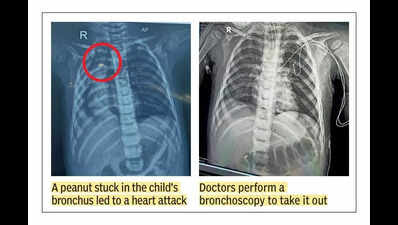
In a heart-stopping medical emergency, an 18-month-old child from Meerut narrowly survived after a peanut remained stuck in the airway for two days, triggering respiratory failure and cardiac arrest. Doctors at a Noida hospital managed to save the toddler following a high-risk operation that lasted nearly six hours.
Initially, the family believed the choking incident was minor and sought local treatment. However, the child’s condition worsened rapidly, with repeated choking episodes and severe breathing difficulty, forcing an emergency transfer to a Noida hospital late at night.
Oxygen Levels Plunge, Heart Stops
Upon arrival, doctors found the child in critical respiratory distress with dangerously low oxygen saturation — reportedly dropping to around 20%. The airway blockage caused by the swollen peanut led to cardiac arrest, requiring immediate advanced life support.
Medical teams rushed to intubate the child and placed them on mechanical ventilation to stabilize breathing before attempting removal of the obstruction.
Six-Hour High-Risk Surgery Saves Life
Specialists discovered the peanut lodged deep inside the right main bronchus. Because organic materials like peanuts absorb moisture and expand, the blockage had become severe and life-threatening.
Using advanced bronchoscopic tools — including cryo-biopsy forceps and a Dormia basket — surgeons carefully extracted multiple fragments of the swollen peanut during a complex procedure lasting five to six hours.
The toddler remained critical for another 24 hours but gradually stabilised and was discharged two days later, bringing immense relief to the family.

Doctors Issue Urgent Warning to Parents
Medical experts say such incidents are alarmingly common and can turn fatal if not treated immediately. Small foods like peanuts can swell inside airways, causing complete obstruction, oxygen deprivation and even brain injury.
Doctors emphasized that prolonged choking should never be ignored and advised parents to supervise young children closely during meals, especially when offering small or hard foods.