
In a major policy shift driven by economic urgency, the Indian government has relaxed business visa rules for foreign technical experts, particularly Chinese engineers and technicians, after strict curbs over the past four years reportedly caused losses of nearly ₹1 lakh crore to Indian industry.
The move is expected to provide a significant boost to key sectors such as electronics manufacturing, solar energy, and industrial equipment, where projects were delayed due to the absence of specialised foreign expertise.
According to a Reuters report, the government has simplified and fast-tracked the business visa process to address bottlenecks created after 2020, when heightened security scrutiny sharply slowed approvals for Chinese nationals.
Digital Platform to Speed Up Visa Approvals
At the heart of the reform is a new digital sponsorship system launched by the Department for Promotion of Industry and Internal Trade (DPIIT). Under this system, Indian companies can issue online sponsorship letters for foreign technical professionals, reducing paperwork and cutting approval timelines.
The visa application process has also been simplified, with several layers of inter-ministerial clearances removed in routine technical cases. Officials said these steps will make approvals faster, more transparent, and industry-friendly.
Manufacturing Sector Gets Maximum Relief
The relaxed rules will directly help industries dependent on imported machinery from China, especially for installation, commissioning, maintenance, and troubleshooting. Electronics and solar manufacturers have long argued that the absence of Chinese engineers slowed production lines and delayed technology transfer to Indian workers.
Industry executives say the lack of foreign specialists not only stalled projects but also disrupted skill training for Indian engineers, affecting productivity and investor confidence.
Visa Curbs After Galwan Clash Took Heavy Economic Toll
Following the Galwan Valley clash in 2020, India tightened visa norms for Chinese citizens, introducing multiple security checks that often stretched approval timelines to several months.
While the move was rooted in national security concerns, it significantly impacted sectors where Chinese technology and expertise play a crucial role. Several electronics and renewable energy projects were postponed or scaled down as a result.
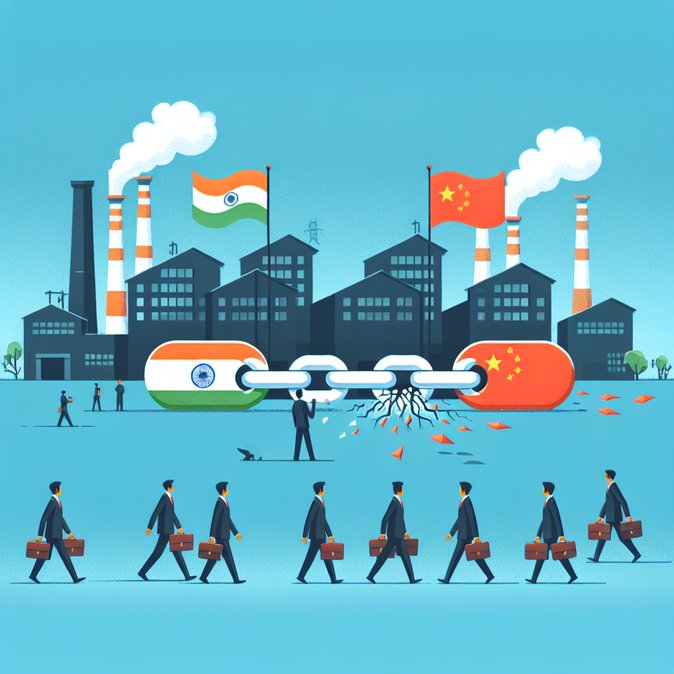
Losses Estimated at Over $15 Billion
According to estimates by the Observer Research Foundation (ORF), India’s electronics sector alone suffered losses of around $15 billion (approximately ₹1.37 lakh crore) over four years due to visa-related disruptions.
Major Chinese-linked companies, including smartphone and component manufacturers, faced prolonged delays in bringing technical staff to India, affecting expansion plans. The solar sector, too, struggled with a shortage of skilled specialists.
Signs of Thaw in India-China Ties
The visa relaxation is also seen as a signal of gradual easing in India-China relations. Prime Minister Narendra Modi recently visited China after a seven-year gap and held talks with President Xi Jinping on stabilising bilateral ties.
China, in turn, has announced the resumption of visa services for Indian citizens, introducing a new online application system. India’s External Affairs Ministry has confirmed that tourist and business visas for Chinese nationals are now being issued again.
Balancing Economic Needs and Strategic Caution
Officials stress that while security checks remain in place, the revised visa framework reflects a pragmatic balance between strategic caution and economic necessity. The government believes the reforms will revive stalled investments, strengthen manufacturing output, and support India’s long-term growth ambitions.