
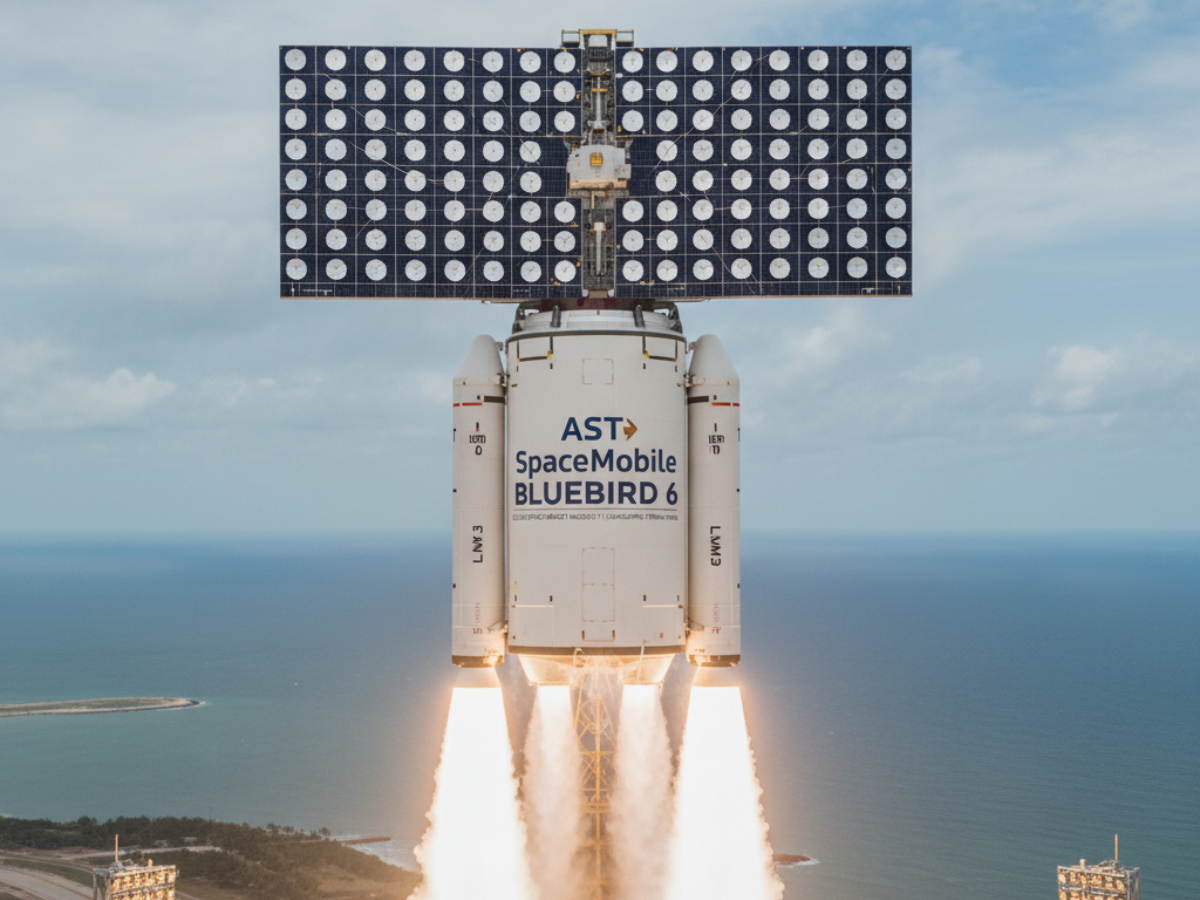
When ISRO’s heavy-lift LVM3 “Bahubali” rocket lifts off from Sriharikota later this year, it will carry more than a satellite into space. The BlueBird-6 mission, scheduled for around December 21, 2025, represents a defining moment for India’s commercial space ambitions and a potential turning point in how the world accesses mobile internet.
At the heart of this mission is BlueBird-6, a massive 6.5-tonne low-Earth-orbit satellite built by US-based AST SpaceMobile, designed to do something revolutionary: beam broadband connectivity directly to ordinary 4G and 5G smartphones—without towers, terminals, or dishes.
A Satellite Designed to Eliminate Digital Blind Spots
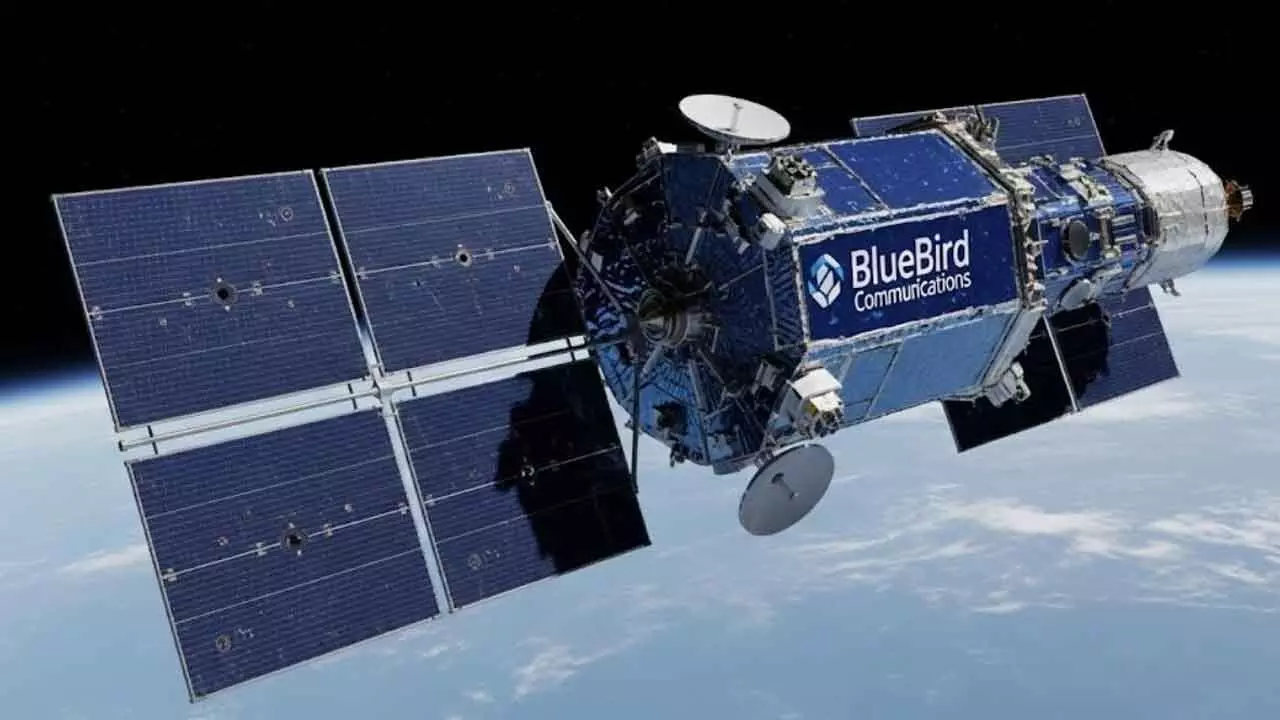
BlueBird-6 is part of AST SpaceMobile’s next-generation direct-to-device (D2D) satellite constellation. Unlike traditional satellite broadband systems that rely on fixed ground equipment, this technology allows regular mobile phones to connect directly to satellites orbiting hundreds of kilometres above Earth.
The satellite carries a 2,400-square-foot phased-array antenna, among the largest ever deployed on a commercial satellite, and supports up to 10,000 MHz of bandwidth. In practical terms, this means the ability to deliver voice, data, and messaging services across vast regions—from remote villages and islands to disaster-hit zones where terrestrial networks fail.
Why ISRO’s Role Is Strategically Crucial
Although BlueBird-6 is an American satellite, India is the launch enabler, and that distinction matters.
This mission is historic on multiple fronts:
●It will be the heaviest US commercial payload ever launched by India
●It underscores ISRO’s growing credibility in high-value commercial launches
●It significantly expands the global footprint of NewSpace India Limited (NSIL), ISRO’s commercial arm
By deploying BlueBird-6 on the LVM3, India positions itself as a cost-effective, reliable alternative to dominant launch providers like SpaceX, Arianespace, and ULA—especially for the rapidly expanding market of LEO broadband constellations.
What Direct-to-Device Broadband Could Change
If operationalised at scale, BlueBird-6-style connectivity could reshape global telecom infrastructure.
Potential impacts include:
●Mobile coverage without towers in remote and rural regions
●Emergency connectivity during floods, earthquakes, or conflicts
●Lower infrastructure costs for telecom operators in emerging economies
That said, challenges remain. Regulatory approvals, spectrum harmonisation, pricing models, and latency management will determine how quickly D2D satellite broadband becomes mainstream. Still, the technological leap itself is undeniable.
A New Phase in India–US Space Cooperation
Beyond technology, BlueBird-6 signals a maturing India–US partnership in space, moving decisively into commercial and industrial collaboration.
For India, the mission brings:
◆Foreign exchange earnings
◆Advanced mission-management experience
◆Greater influence in global space supply chains
For the United States, it offers a trusted, non-Western launch partner, aligning with Washington’s push to diversify space infrastructure dependencies.
A Reflection of India’s New Space Vision
The mission fits squarely within India’s New Space Policy, which encourages public-private collaboration and global commercial integration. It also redefines the role of the LVM3 “Bahubali”, transitioning it from a primarily national mission launcher to a globally competitive heavy-lift vehicle.
India is no longer positioning space merely as a domain of exploration—but as critical digital infrastructure for the world.
A Launch with Global Implications
For ISRO, BlueBird-6 is not just a contract—it is a statement of capability, confidence, and ambition. As the rocket rises from Sriharikota, it will symbolise India’s emergence as a key architect of the future digital ecosystem.
In carrying BlueBird-6 to orbit, India is helping build a world where connectivity is not limited by geography, and where space becomes a bridge—linking nations, markets, and people in pursuit of truly global broadband equity.