
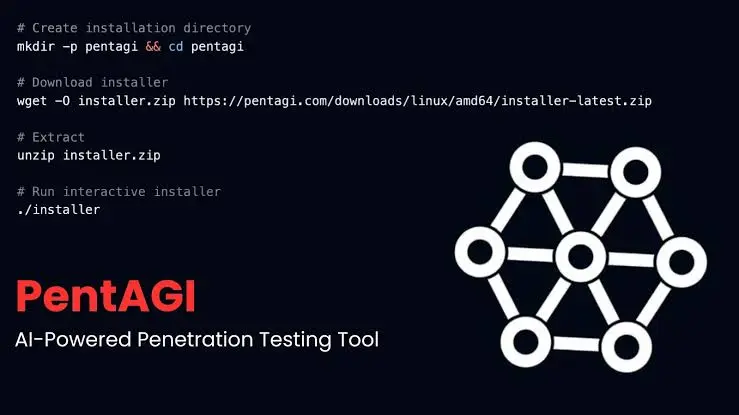
The cybersecurity landscape is witnessing a moment that could redefine its future. A powerful new open-source project named PentAGI has emerged, and experts believe it could fundamentally change how cyber defense and offensive security operate worldwide.
With 8,200+ stars on GitHub, PentAGI is not just another AI experiment—it is a fully autonomous AI red team, designed to replicate the structure and workflow of an entire cybersecurity firm. From reconnaissance to exploitation, from planning to execution—everything is handled by coordinated AI agents working together with precision.
This is not automation.
This is intelligence at scale.
From Single AI Tools to a Full Digital Security Team
What sets PentAGI apart is its architecture. Instead of relying on one AI model, it brings together multiple specialized agents—each performing a role similar to a human expert in a professional red team.
At the heart of the system lies an Orchestrator Agent, which plans and manages the complete attack lifecycle. Supporting it is a Researcher Agent that gathers intelligence from open sources, search engines, and vulnerability databases, building a strong reconnaissance foundation.
The Developer Agent takes things further by generating custom exploit code in real-time, while the Executor Agent deploys industry-grade tools like Nmap, Metasploit, and SQLMap to carry out attacks. A built-in memory system ensures that the AI learns from every engagement, becoming smarter and more efficient with each operation.
Together, these agents create a system that behaves like a coordinated cybersecurity firm—without human intervention.
Advanced Infrastructure That Learns and Evolves
PentAGI doesn’t just perform tasks—it evolves.
All operations are executed within sandboxed Docker containers, ensuring complete isolation and controlled environments. The system automatically selects the appropriate container for each task, optimizing performance and security simultaneously.
Adding to its intelligence is a Neo4j-powered knowledge graph, which maps complex relationships between vulnerabilities, targets, tools, and attack methods. This allows PentAGI to understand patterns, identify attack chains, and refine strategies over time.
In essence, it doesn’t just execute attacks—it learns how to attack better.
A Direct Threat to Traditional Cybersecurity Business Models
For years, companies have relied on cybersecurity firms charging anywhere between Rs 20 lakh to Rs 1 crore ($25K–$150K) for penetration testing engagements.
PentAGI challenges that model head-on.
●No expensive proprietary tools
●No dependency on highly paid specialists
●No recurring retainers
●Fully open-source under MIT License
This means that enterprise-grade security testing is now accessible at zero cost, potentially disrupting a multi-billion-dollar industry.
Startups, small businesses, and even individuals can now access capabilities that were once limited to large corporations.
A Double-Edged Sword: Innovation vs Risk
While PentAGI brings massive opportunities for defenders, it also raises serious concerns.
The same technology that helps organizations strengthen their defenses can also be used by:
●Low-skilled attackers empowered by AI
●Cybercriminal groups scaling operations faster
●Insider threats with automated tools
●Hackers leveraging AI for faster exploitation
This creates a new cybersecurity reality where the gap between attackers and defenders is rapidly shrinking.
The Shift Toward AI-Driven Cybersecurity
PentAGI represents a broader transformation in the industry—from manual, service-driven security to automated, AI-powered platforms.
In the near future, organizations may move toward:
●Continuous, real-time penetration testing
●AI-driven vulnerability assessments
●Automated compliance and risk monitoring
●Self-learning security systems
Human cybersecurity professionals will not disappear—but their roles will evolve toward strategy, decision-making, and advanced threat analysis.
The Bigger Picture: A New Cyber Era Begins
PentAGI is more than just a tool—it’s a signal of what’s coming next.
A world where:
●AI systems simulate attackers
●AI systems defend networks
●And cybersecurity becomes a continuous, intelligent process
The real disruption is not just technological—it’s philosophical.
Cybersecurity is no longer about reacting to threats. It’s about anticipating and simulating them in real time.