

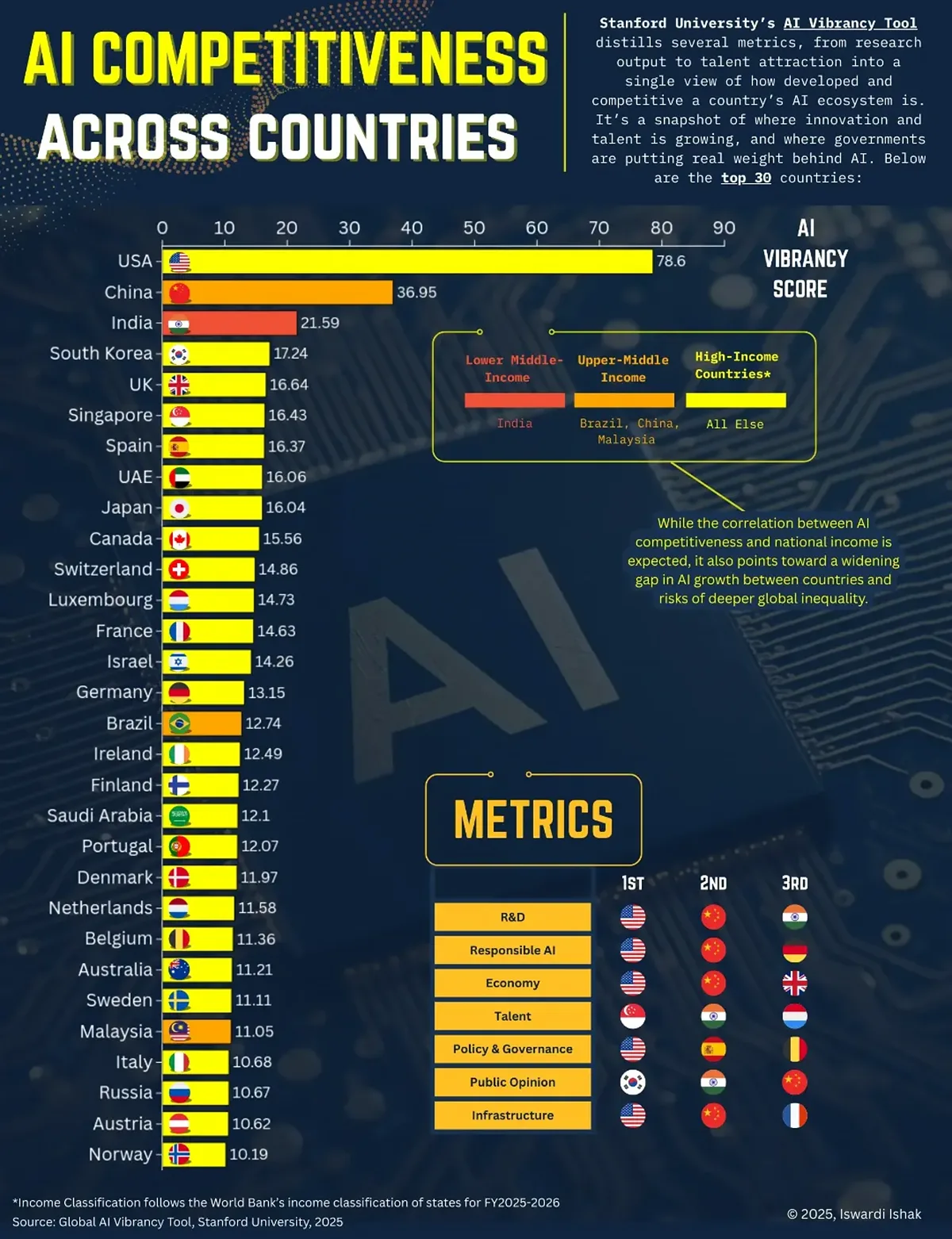
India has firmly established itself as a global powerhouse in Artificial Intelligence, ranking third worldwide in AI competitiveness, according to Stanford University’s prestigious Global AI Vibrancy Tool 2025. The country now stands just behind the United States and China, marking one of the most significant technological leaps in India’s recent history.
The report, which tracks AI progress across research, talent, innovation, and investment between 2017 and 2024, highlights India’s rapid rise as an emerging strategic hub for artificial intelligence.
A Historic Leap in Global AI Rankings
Stanford’s findings reveal that India has outperformed several advanced economies to secure the third position globally. While the US and China continue to dominate large-scale AI infrastructure and capital, India’s strength lies in speed, scale, and talent-driven innovation.
The study credits India’s strong showing in:
◆AI startup creation
◆Research publications
◆Patent filings
◆Industry-led AI deployment
Over the last five years, India has recorded one of the fastest AI growth rates in the world.
AI Talent Boom and Research Excellence
India’s AI workforce has tripled since 2018, driven by rising demand across industries and a growing emphasis on advanced technical education. Institutions such as IITs, IISc, and IIITs are now globally recognised for cutting-edge AI research.
India’s contribution to global AI research papers has risen sharply—from 3% in 2017 to more than 7% in 2024—with major breakthroughs in healthcare diagnostics, fintech, climate modelling, and agricultural technologies.
The surge in AI-related patent filings further signals India’s shift from service-based adoption to deep innovation and intellectual property creation.
Government Push Fuels AI Acceleration
The report highlights India’s policy-driven approach as a key factor behind its rise. Initiatives such as:
◆National AI Strategy
◆AI for All Mission
◆Startup India
◆AI Centres of Excellence (CoEs)
have created a robust foundation for AI research, skill development, and ethical deployment.
AI and machine learning are now embedded into technical education curricula, ensuring a steady pipeline of skilled professionals.
Private Sector and Corporate Investment
India’s technology giants have played a pivotal role in scaling AI adoption. Companies including TCS, Infosys, Wipro, and Reliance Jio have invested heavily in AI-led automation, cybersecurity, cloud platforms, and customer intelligence systems.
These investments have accelerated digital transformation across banking, telecom, manufacturing, and public services.
Booming AI Startup Ecosystem
Stanford’s report notes that India is now home to over 3,500 AI-focused startups, which have collectively raised more than USD 8 billion in funding.
Cities such as Bengaluru, Hyderabad, Pune, and Delhi-NCR have emerged as major AI innovation corridors, fostering collaboration between startups, universities, and global investors.
Indian AI startups are deploying solutions in:
●Precision agriculture
●Healthcare diagnostics
●EdTech and skilling
●Smart cities and governance
What Lies Ahead
The study forecasts that India’s AI growth could double over the next decade, provided the country continues investing in data governance, advanced research, and skill development.
With its vast talent pool, digital infrastructure, and demographic advantage, experts now describe India as the “third global pole of artificial intelligence”, alongside the US and China.
A New Chapter in India’s Tech Leadership
India’s rise to the global AI top three marks a decisive shift—from an emerging digital economy to a frontline leader in innovation-driven growth. Artificial Intelligence is now set to become a cornerstone of India’s future, driving economic expansion, job creation, and global competitiveness.