
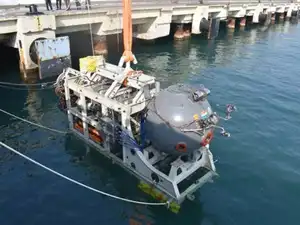
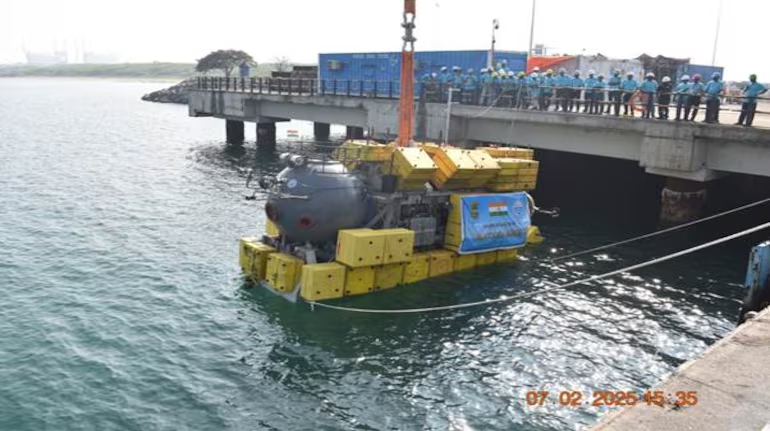
In a landmark moment for Indian science and engineering, India is set to become the sixth country ever to send humans to a depth of 6,000 meters below the ocean surface, thanks to the indigenous Matsya-6000 submersible developed by the National Institute of Ocean Technology (NIOT).
What’s Matsya-6000?
Designed as part of the government’s ambitious Samudrayaan Mission, the Matsya-6000 can carry three persons into the Indian Ocean’s depths.
Built around a titanium‐alloy spherical crew cabin that withstands over 600 atmospheres of pressure.
Dimensions: approximately 4 meters long, weighs around 5.5 tons, and capable of operating for up to 12 hours underwater.
Why It Matters
With India’s coastline exceeding 7,500 km, mastering deep‐sea exploration opens immense strategic and economic doors.
The mission is geared toward exploring marine biodiversity and extracting deep‐sea resources like polymetallic nodules (containing nickel, cobalt, manganese).
Technologically, Matsya-6000 signifies India’s growing self‐reliance in complex marine systems, reinforcing the “Make in India” vision.
Global Context
Only five countries — the United States, Russia, China, Japan, and France — can currently claim deep‐sea manned missions beyond 5,000 meters. India’s inclusion marks a new chapter in global ocean exploration.
Technical Highlights & Safety Features
Equipped with robotic arms to collect samples from seabed.
High‐definition cameras and powerful LED lighting allow detailed imagery in near‐complete darkness.
Emergency systems include auto‐detach capability, 96‐hour oxygen reserve, and location beacon for rescue operations.
Future Vision
NIOT is already planning follow‐up missions targeting even greater depths and envisioning permanent underwater research stations. The deep‐ocean frontier is being positioned as the next big battleground in science, resources and climate studies.