

In a major nationwide action to protect lakhs of daily bus travellers, the National Human Rights Commission (NHRC) has issued a strong directive to all Chief Secretaries, ordering immediate removal of unsafe sleeper buses that violate safety norms — a move triggered by a series of horrifying bus fires, including the tragic Rajasthan incident that killed 20 passengers.
The NHRC has warned that the long-ignored design flaws in sleeper buses are now a direct threat to the Right to Life under Article 21, and states can no longer look the other way.
Why NHRC Stepped In: Fatal Flaw in Sleeper Bus Design
In its notice, the NHRC highlighted a disturbing and recurring issue:
●Many sleeper buses have a fully enclosed driver’s cabin, cut off from the passenger area.
●This prevents the driver from detecting fires early or communicating with passengers during emergencies.
●Passengers often realise danger too late — making timely evacuation impossible.
The Commission noted that this design defect has already led to multiple preventable deaths, calling it systemic negligence by bus manufacturers and approving authorities.
NHRC’s Immediate Directions
The bench led by Member Priyank Kanoongo took suo motu cognisance of the matter under Section 12 of the Protection of Human Rights Act, 1993.
The Commission has ordered:
● Removal of all unsafe sleeper buses violating safety rules
● Detailed probe report from Ministry of Road Transport & Highways
● Accountability of state transport departments and manufacturers
● Action Taken Report within 2 weeks
Notices have been issued to:
●Ministry of Road Transport and Highways (MoRTH)
●Central Institute of Road Transport (CIRT), Pune
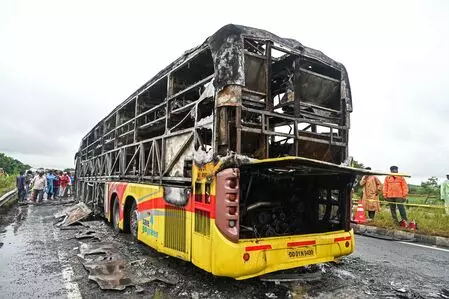
Shocking Findings from Technical Investigation
After the fatal Rajasthan fire, the CIRT conducted an investigation starting October 18, 2025.
Their findings revealed:
●Major violations in bus body construction
●Non-adherence to safety standards of Central Motor Vehicles Rules (CMVR)
●Design structures that accelerate fire spread
●Lack of proper emergency exits
These findings have been formally submitted to the Rajasthan Transport Department.
What Safety Standards Were Violated?
MoRTH has already mandated strict standards:
🔹 AIS:052 – General bus body design norms
🔹 AIS:119 – Sleeper bus-specific safety rules
Key mandatory features include:
● Driver cabin partitions not allowed
● Fire Detection & Suppression System (FDSS) compulsory since 2019
● Minimum 4 emergency exits for 12m buses
● Minimum 5 emergency exits for buses longer than 12m
Most of the seized sleeper buses failed to meet these basic life-saving requirements.
Why This Matters
India records some of the world’s highest road-accident fatalities. Sleeper buses — heavily used for long-distance travel at night — pose an even higher risk due to:
●Locked or jammed windows
●Narrow aisles
●Highly flammable interiors
●Delayed fire detection
The NHRC’s intervention is expected to force a nationwide clean-up of dangerous buses that have operated unchecked for years.
A Crucial Step Towards Safer Travel in India
The NHRC has made it clear:
Passenger safety cannot be compromised.
States must act immediately to protect lives before another preventable tragedy strikes.