
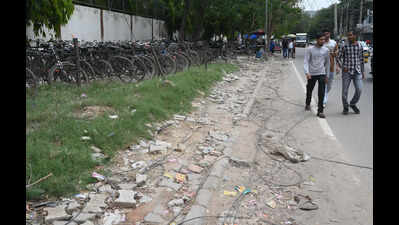
What should be a simple walk home has turned into a daily survival challenge in Udyog Vihar—one of Gurugram’s busiest industrial and corporate zones. With missing or unusable footpaths, pedestrians are left with no choice but to share road space with fast-moving traffic, raising serious safety concerns.
A 500-Metre Walk That Feels Like a Hazard Zone
For 26-year-old Nishi Mathur, stepping out of her office in Udyog Vihar Phase 3 each evening means navigating through chaos. A short 400–500 metre walk to reach the main road becomes a stressful experience as she carefully dodges cars, bikes, and rickshaws.
With no continuous footpaths, she walks along narrow road edges, broken patches, and ramps—spaces that are often taken over by two-wheelers trying to bypass traffic. What should take minutes instead becomes a cautious, high-risk journey.
Thousands Face the Same Daily Struggle
Nishi’s experience is far from isolated. Udyog Vihar, home to nearly 2,500 factories and offices, witnesses thousands of employees walking daily—yet pedestrian infrastructure remains almost non-existent.
In many stretches, footpaths are either:
●Completely missing
●Encroached by vendors
●Blocked by parked vehicles
●Damaged and unusable
As a result, pedestrians are forced onto the main carriageway, directly into the path of traffic.
Parking Chaos Making Matters Worse
One of the biggest reasons behind the disappearing walking space is rampant on-street parking. Despite rules prohibiting roadside parking, vehicles are routinely parked along internal roads and even on whatever little footpath space exists.
Officials from Haryana State Industrial and Infrastructure Development Corporation have acknowledged that unauthorised parking continues despite enforcement efforts, including fines and challans by traffic police.
Experts point out that many industrial units lack adequate in-house parking, forcing employees to occupy public road space—further shrinking already limited pedestrian areas.
Monsoon Turns It Into a Nightmare
The situation worsens significantly during rains. Waterlogging, potholes, and clogged drains eliminate even the narrow walking edges that pedestrians rely on.
Employees are then forced to walk directly on roads alongside moving vehicles, increasing the risk of accidents and slowing down traffic flow at the same time.

Outdated Planning Meets Modern Pressure
Urban planners believe the root of the problem lies in outdated infrastructure design. Udyog Vihar’s roads were never built to handle today’s volume of traffic and footfall.
According to experts like Sarika Panda Bhatt of Raahgiri Foundation, simply building footpaths won’t solve the issue unless:
●On-street parking is strictly controlled
●Internal parking is developed within offices
●Footpaths are redesigned with proper drainage and planning
Without coordinated efforts, the crisis is likely to persist.
A City Built for Cars, Not People
Despite being a major employment hub, Udyog Vihar continues to prioritise vehicles over pedestrians. Even during lunch hours, large groups of employees can be seen walking along roads—highlighting the constant demand for safe walking spaces.
The absence of basic pedestrian infrastructure not only endangers lives but also disrupts traffic flow, creating a cycle of congestion and risk.