
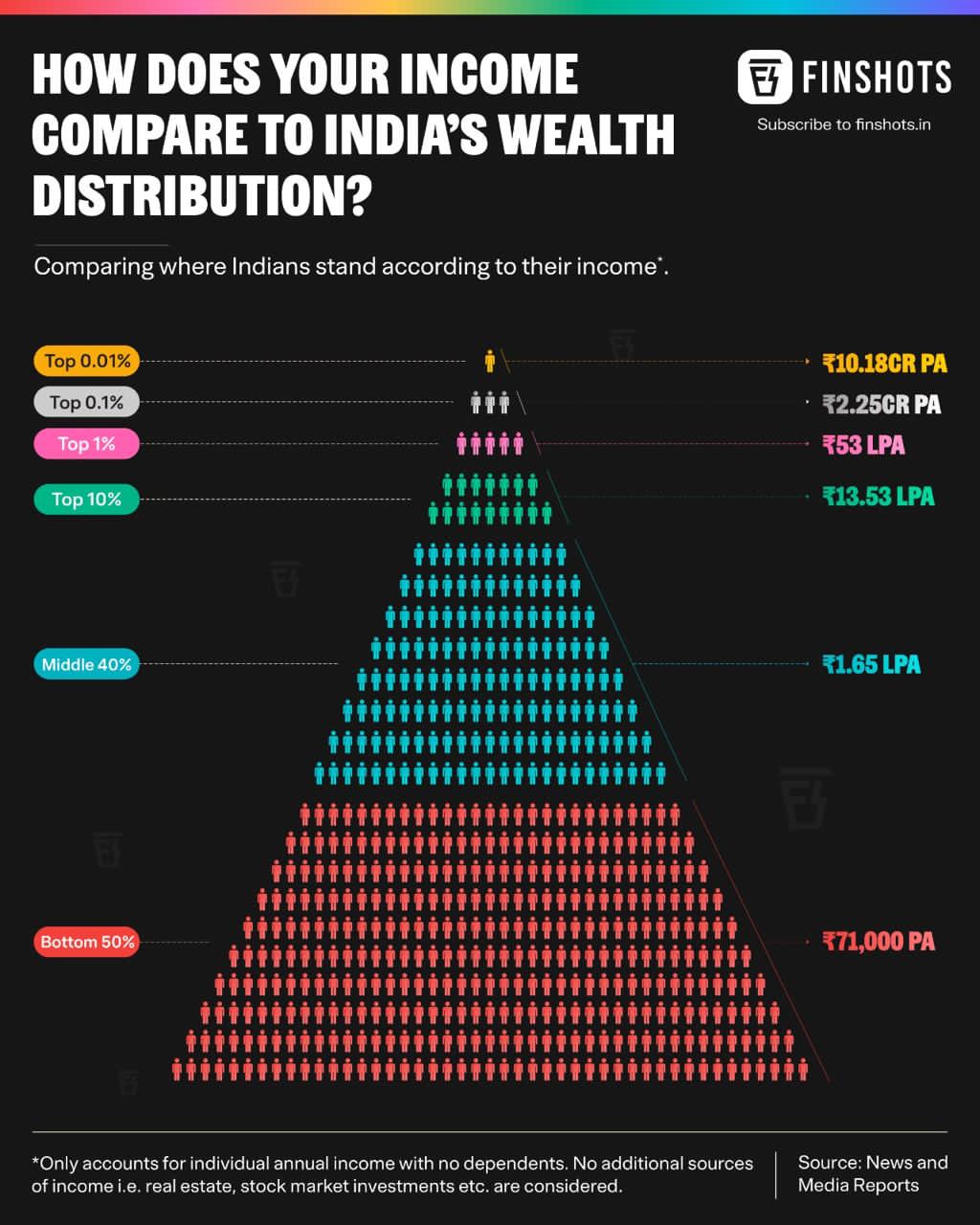
A new breakdown of India’s income distribution has taken social media by storm — and for all the right (and wrong) reasons. Shared by Finshots, the chart lays bare the harsh truth about how India’s wealth is stacked… and the contrast is nothing short of staggering.
At a time when India is being celebrated as the world’s fastest-growing major economy, the income inequality inside the country is sparking fresh debate. The numbers tell a brutally honest story of two Indias — one racing ahead, and one struggling to survive.
The Ultra-Rich: India’s Economic Peak
The top slice of India’s income ladder is shockingly steep:
Top 0.01% → earning over Rs 10.18 crore per year
Top 0.1% → earning Rs 2.25 crore per year
Top 1% → earning Rs 53 lakh per year
Top 10% → earning Rs 13.53 lakh per year
Just this one fact is blowing people’s minds online:
If you earn more than Rs 13.5 lakh a year, you’re already in India’s Top 10% richest individuals.
This revelation has left many surprised — because what is “middle class” for urban India is actually the top layer of the pyramid statistically.
Middle 40%: India’s Real ‘Working Class’
The middle 40% — the true backbone of the Indian workforce — earns an average of just ₹1.65 lakh per year.
This group includes:
●salaried employees
●small shop owners
●gig workers
●entry-level professionals
●daily earners
They earn, they work hard, they contribute — yet their income barely keeps pace with inflation, housing costs, fuel, and basic essentials.
Bottom 50%: India’s Most Alarming Statistic
The most heartbreaking part of the data is this:
50% of Indians earn Rs 71,000 or less per year — around Rs 6,000 a month.
This means half the population is living with:
●minimal savings
●unstable incomes
●zero financial cushion
●intense vulnerability to price hikes
Economists say this widening gap could become a major risk for long-term economic stability.
Why This Breakdown Has Gone Viral
The chart is sparking massive discussion online because it highlights:
●India’s growing income inequality
●shrinking purchasing power among the masses
●fastest rise in the ultra-rich segment
●pressure on middle India
●urgency for stronger job creation and wage reforms
The data also raises big questions about:
●taxation policies
●social welfare distribution
●the future of India’s middle class
the sustainability of growth focused on the top income earners
A Mirror India Cannot Ignore
As India aims for Viksit Bharat 2047, this income pyramid acts as a powerful reminder: true development must lift the bottom half, expand opportunities for the middle 40%, and make growth more inclusive.
For now, this viral chart has forced the nation to confront a hard truth — the gap between India’s richest and the rest is far wider than most imagined.