
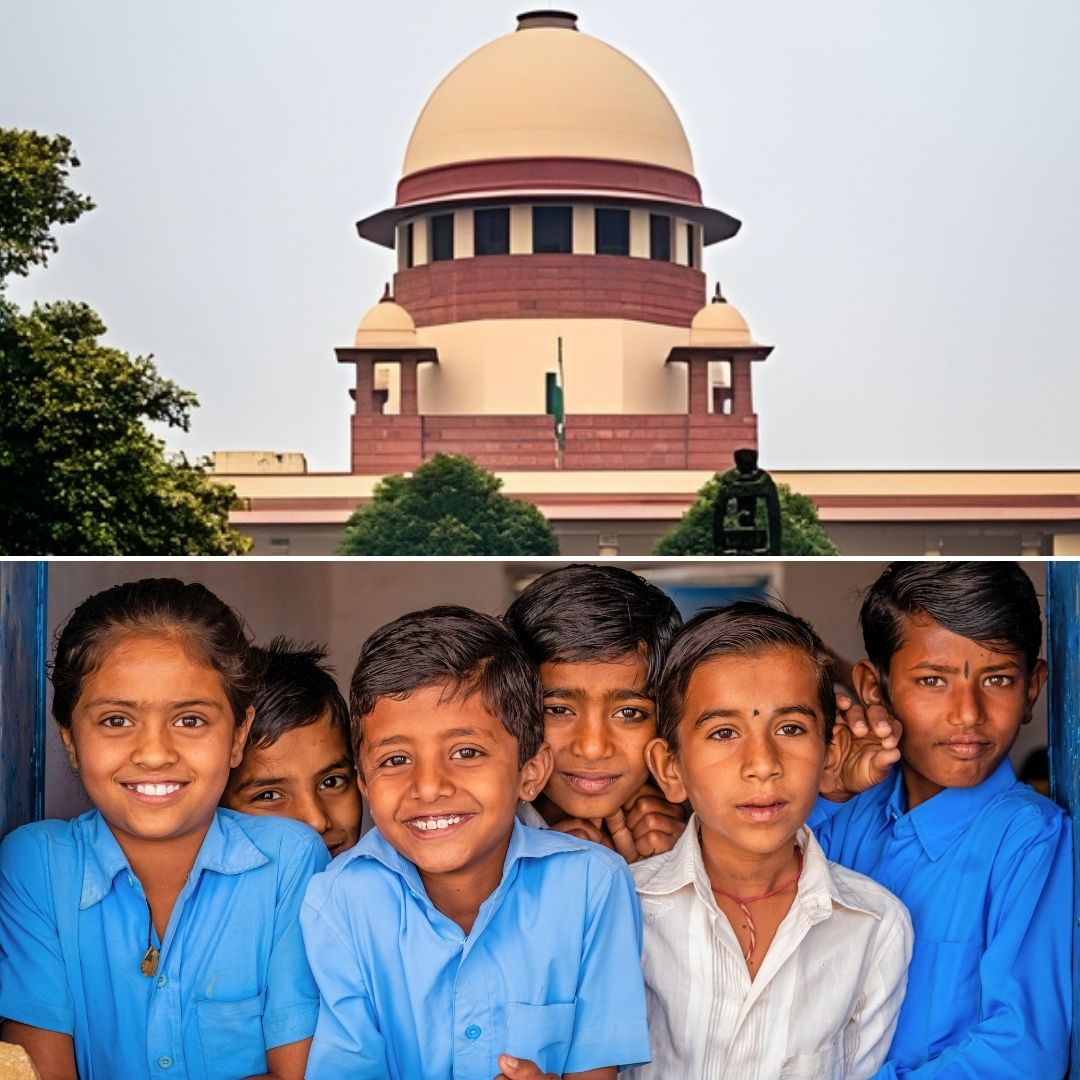
In a landmark ruling, the Supreme Court has delivered a strong message on the implementation of the Right to Education (RTE) Act, directing both the Centre and state governments to strictly enforce the mandatory 25% quota for Economically Weaker Section (EWS) and disadvantaged group students in private unaided, non-minority schools.
The apex court said that providing quality education to children from poor and marginalised backgrounds is not merely a welfare measure but a constitutional obligation and a national mission. The judgment was delivered by a bench comprising Justice P.S. Narasimha and Justice A.S. Chandurkar.
“True Brotherhood Begins in the Classroom”
While underlining the constitutional value of fraternity, the court observed that true social equality can only be achieved when children from all economic backgrounds study together.
“The constitutional goal of fraternity will be fulfilled only when the child of a rickshaw-puller studies alongside the child of a millionaire or a Supreme Court judge,” the court remarked.
The bench said Section 12(1)(c) of the RTE Act is not a symbolic provision, but a powerful tool to ensure equality, dignity, and holistic development of children, as envisioned under Articles 21A and 39(f) of the Constitution.
Clear Rules Needed for Effective Implementation
The Supreme Court expressed concern over inconsistent implementation of the EWS quota across states and stressed the need for clear and uniform rules under Section 38 of the RTE Act. These rules must specify the procedure, eligibility, and admission mechanism for EWS and disadvantaged children in neighbourhood private schools.
The court also rejected the argument that children from weaker sections may struggle to adjust in elite school environments. It said the responsibility lies with teachers and educational institutions to foster inclusion, confidence, and self-respect among all students.
Directions to Governments and Child Rights Bodies
The court directed authorities to frame and notify necessary rules after consulting:
◆National Commission for Protection of Child Rights (NCPCR)
◆State Commissions for Protection of Child Rights (SCPCRs)
National and State Advisory Councils
The NCPCR has been asked to collect details from all states and Union Territories regarding the framing of rules and submit an affidavit to the Supreme Court by March 31. The matter will be heard next on April 6.
Background of the Case
The ruling came while hearing a Special Leave Petition filed by a parent whose children were denied admission under the EWS quota in a neighbourhood private school in 2016 despite vacant seats. After approaching the Bombay High Court, the matter eventually reached the Supreme Court, leading to this significant verdict.