
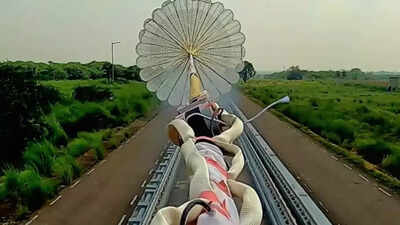
What do railway tracks have to do with sending astronauts to space? Quite a lot, as it turns out.
The Indian Space Research Organisation (ISRO) has successfully completed critical drogue parachute qualification tests for its ambitious Gaganyaan human spaceflight mission, using a high-speed rail track rocket sled—a move that highlights India’s innovative approach to astronaut safety.
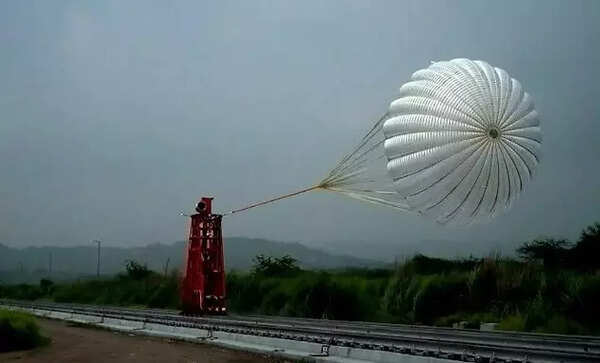
The tests were conducted on December 18 and 19, 2025, at the Rail Track Rocket Sled (RTRS) facility of the Terminal Ballistics Research Laboratory (TBRL) in Chandigarh. The trials mark a major milestone in ensuring the safe return of Indian astronauts to Earth.
Why These Tests Are Crucial for Gaganyaan
One of the most challenging phases of any human spaceflight is re-entry into Earth’s atmosphere. The Gaganyaan Crew Module will travel at extremely high speeds while returning from space, making controlled deceleration absolutely critical.
This is where drogue parachutes come into play.
According to ISRO, the objective of the recent trials was to evaluate the performance, reliability, and robustness of these parachutes under extreme and off-nominal conditions. The results were encouraging—both tests met all mission objectives, confirming that the system performs exactly as designed.
The trials were carried out in close coordination with the Vikram Sarabhai Space Centre (VSSC), Aerial Delivery Research and Development Establishment (ADRDE), and DRDO, underlining a strong inter-agency collaboration.
Space Science on Railway Tracks: How It Works
While rail tracks are typically associated with trains, the RTRS facility allows a rocket sled to accelerate to extremely high speeds, closely simulating the conditions experienced during atmospheric re-entry.
This setup enables engineers to test spaceflight systems on Earth with high accuracy, without the risks of live flight testing.
The drogue parachutes are designed to stabilise the Crew Module and reduce its speed to a safe level, allowing the main parachutes to deploy smoothly.
A 10-Parachute Safety Shield for Astronauts
The Gaganyaan Crew Module uses a multi-layered, 10-parachute deceleration system, designed with redundancy and safety at its core:
◆2 Apex Cover Separation parachutes to remove the protective cover
◆2 Drogue parachutes for initial stabilisation and speed reduction
◆3 Pilot parachutes to assist deployment
◆3 Main parachutes to ensure a safe landing on land or sea
This carefully sequenced architecture ensures maximum safety during the final moments of the mission.
A Strong Step Towards India’s First Crewed Mission
ISRO officials said the successful tests significantly boost confidence in the parachute system’s readiness for human spaceflight. The use of railway-based rocket sled testing reflects India’s engineering ingenuity and its uncompromising focus on astronaut safety.
With each successful trial, India moves closer to joining an elite group of nations capable of independently sending humans to space.
The Big Picture
What may appear to be an experiment on railway tracks is, in reality, a cornerstone of India’s space ambitions. By validating Gaganyaan’s parachute system through high-speed rail testing, ISRO has taken another decisive step towards ensuring that India’s first astronauts not only reach space—but return home safely