
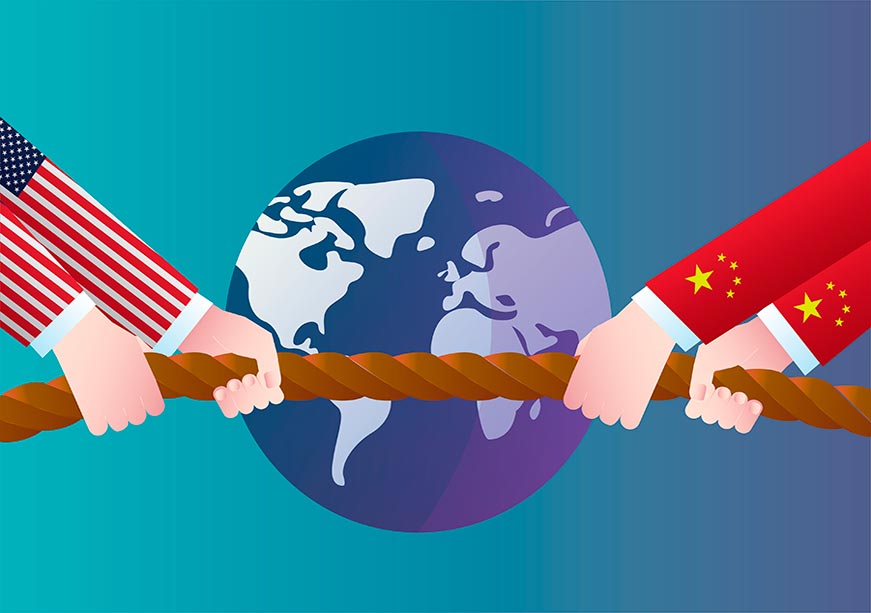
As rivalry between the United States and China sharpens, a deeper anxiety is taking hold across Asia. The fear is no longer about a world jointly managed by Washington and Beijing — a so-called “G2” order — but about something far more unsettling: a “G1” world dominated almost entirely by China.
This unease intensified after former U.S. President Donald Trump openly revived the idea of a U.S.-China condominium following his recent interactions with Chinese President Xi Jinping. Across Asian capitals, from Tokyo to New Delhi and Seoul, policymakers worry that such an arrangement would marginalise regional powers and compress their strategic autonomy.
Japan’s former foreign policy adviser Tomohiko Taniguchi described the idea bluntly as “nightmarish,” warning that it would effectively drag Japan into China’s geopolitical orbit. Indian officials echo similar concerns, fearing that Asia’s balance of power could tilt decisively toward Beijing with little room for independent manoeuvre.
Singapore, however, offers a more cautious reading. Foreign Minister Vivian Balakrishnan has characterised the current phase as a “tactical pause” rather than a strategic convergence, arguing that deep mistrust between the two superpowers still prevents any lasting alignment. Yet beneath this calm assessment lies a more troubling question: Is China already moving toward uncontested primacy in Asia?
America’s Waning Influence in Asia
The latest Asia Power Index 2025 by the Lowy Institute reinforces those fears. The United States has recorded its weakest-ever performance in the region, with analysts concluding that recent American policy choices have eroded Washington’s influence faster than anticipated. One former NATO official went so far as to describe the trajectory as “soft power suicide.”
This decline is not merely diplomatic. It reflects deeper inconsistencies in U.S. economic engagement, trade policy, and long-term regional commitment — areas where China has demonstrated patience, scale, and strategic focus.
China’s Leap from Factory to Innovator
Once dismissed as the world’s assembly line, China has decisively moved up the value chain. Today, it leads or competes at the frontier in electric vehicles, pharmaceuticals, artificial intelligence, defence manufacturing, and clean energy technologies.
Xiaomi’s transformation captures this shift vividly. Once known only for smartphones, the company pivoted aggressively after U.S. sanctions in 2021. Within three years, it unveiled its first electric vehicle, the SU7 — a model that recently achieved 359.7 km/h at Germany’s Nürburgring, outperforming established names like Porsche and Tesla. The irony is striking: European automakers now seek partnerships with Chinese firms they once accused of intellectual property theft.
Energy, Environment, and Industrial Scale
China’s dominance extends beyond technology into the foundations of the next industrial era. It controls vast segments of the global supply chain for solar panels, wind turbines, batteries, and electric vehicles — industries central to the energy transition.
Energy analyst Jarand Rystad sums it up succinctly: “China now leads in every fast-growing industrial segment that defines the future.”
Beijing has also invested heavily in environmental restoration. Over the past two decades, China has reforested an area roughly the size of Japan. Once notorious for polluted skies, Beijing today records air quality improvements that contrast sharply with worsening smog across parts of South Asia.
Military Power with Technological Teeth
China’s military modernisation has kept pace with its economic rise. The launch of its latest aircraft carrier, Fujian, equipped with an electromagnetic aircraft launch system, places it in an elite technological club once monopolised by the U.S. Navy.
Regional conflicts have further sharpened attention. Defence analysts note that Chinese-made PL-15 missiles used by Pakistan reportedly outperformed Western platforms during recent hostilities, raising uncomfortable questions about shifting military balances. Some experts even predict that China could become the first major power to deploy humanoid robots in combat environments.
Economic Strains, Structural Strength
China’s economy is not without problems. A property slowdown, demographic pressures, and internal competition have created visible strains. Yet most economists view these as cyclical challenges rather than structural weaknesses.
Beijing’s command over logistics, manufacturing ecosystems, and long-term planning remains unparalleled. As one Western executive observed, “China has become the fitness centre of global manufacturing.”
Asia’s Strategic Anxiety
What unsettles Asian nations most is not China’s success, but its growing willingness to leverage power coercively. Australia faced trade retaliation over a Covid-19 inquiry. South Korea was punished economically for hosting a U.S. missile defence system.
India, recently recognised as a “major power” in the Lowy Index, continues to face diplomatic friction — including incidents involving Chinese claims over Arunachal Pradesh. Southeast Asian states like Indonesia and Malaysia quietly worry about maritime disputes and industrial dumping that undercut local economies.
The G1 Question
A “G2” world might still preserve balance, ensuring that Asian nations retain diplomatic room between competing powers. A “G1” world, dominated by China alone, would be far more destabilising.
It would test Asia’s political independence, economic resilience, and security confidence in ways unseen since the Cold War — but without the stabilising counterweight of an equally committed rival.
The idea of a “G1” order is no longer theoretical. It is approaching fast — and for much of Asia, that reality is deeply unsettling.