
The Union Government has introduced the Viksit Bharat Education Institution Bill, 2025, a landmark legislation aimed at overhauling India’s higher education system and aligning it with the vision of a developed India (Viksit Bharat). Union Education Minister Dharmendra Pradhan tabled the Bill in the Lok Sabha, and the government has agreed to send it to a Joint Parliamentary Committee (JPC) for detailed examination.
The proposed law seeks to grant greater autonomy to universities while simultaneously strengthening accountability, transparency, and academic standards across the country’s higher education ecosystem.
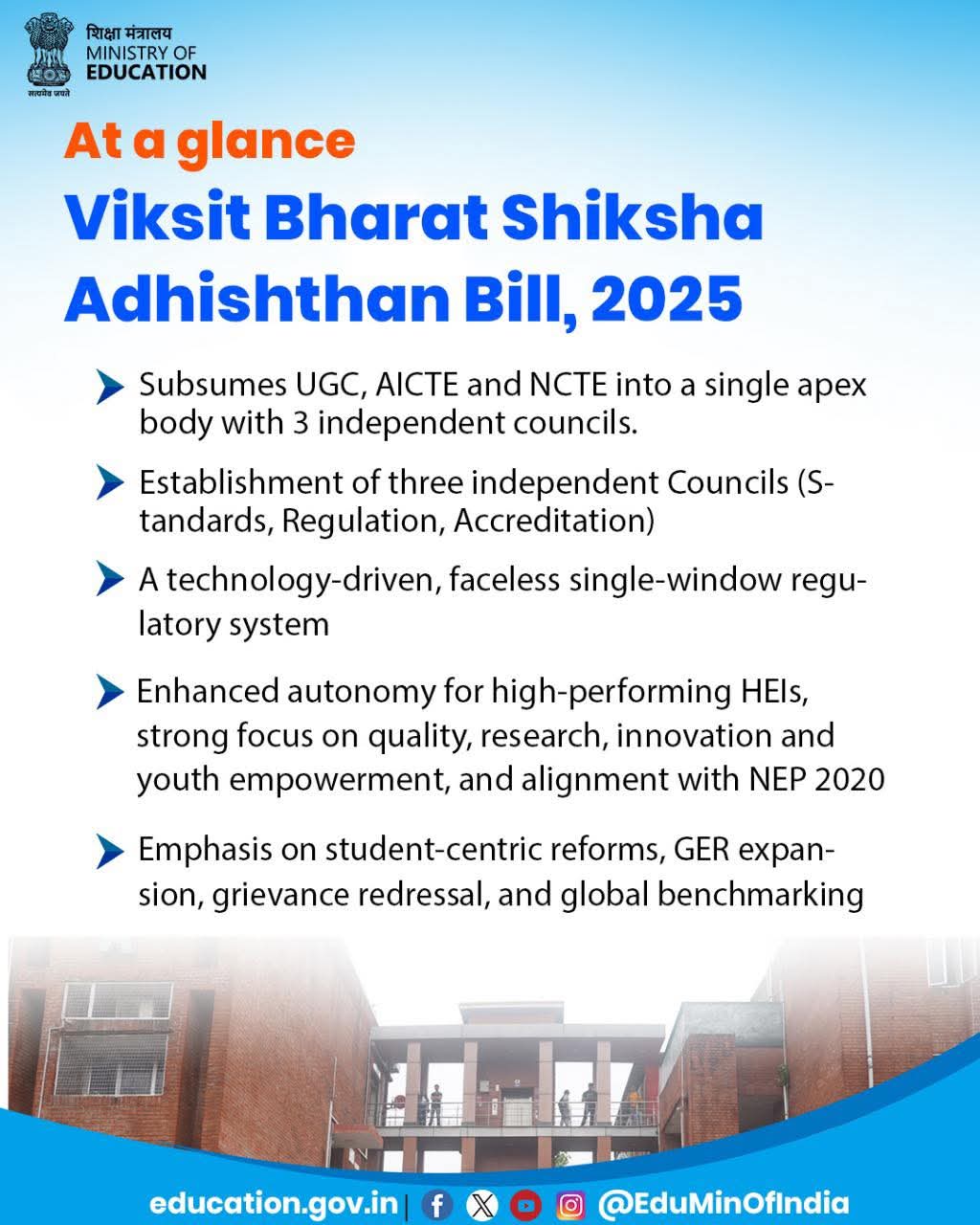
One Apex Commission, Three Dedicated Councils
At the heart of the Bill is the creation of a statutory Higher Education Commission, envisioned as the apex body for policy-making, coordination, and strategic guidance. The commission will advise the government, promote India as a global education hub, and integrate Indian knowledge systems and regional languages into higher education.
The commission will consist of:
●A Chairperson
●Senior academicians and subject experts
●Representatives of the Central Government
●A full-time Member Secretary
To avoid overlapping responsibilities, the commission will function through three independent councils, each with clearly defined roles.
Roles of the Three Councils
Regulatory Council:
Will oversee governance, financial transparency, grievance redressal mechanisms, and curb the commercialization of education.
Accreditation Council:
Will manage institutional accreditation, set eligibility benchmarks, empanel accreditation agencies, and ensure public disclosure of accreditation outcomes.
Standards Council:
Will define academic benchmarks, learning outcomes, credit transfers, faculty qualifications, and student mobility norms across institutions.
Institutions Covered Under the Bill
The law will apply to:
●Central and State Universities
●Deemed Universities
●IITs, NITs, and Institutions of National Importance
●Colleges, online and distance-learning institutions
●Institutions of Eminence
While professional courses such as medical, law, pharmacy, nursing, and allied health sciences will remain outside the Bill’s direct ambit, they will still be required to follow the newly prescribed academic standards.
Expanded Role of the Central Government
Under the proposed framework, the Central Government will have the authority to:
●Issue policy-level directions
●Appoint key leadership positions
●Approve foreign universities to operate in India
●Temporarily dissolve the commission or councils in extraordinary situations
All institutions and bodies will be accountable through annual reports, parliamentary oversight, and audits by the Comptroller and Auditor General (CAG).
Preparing Students for the Future
The Bill emphasizes student-centric, holistic education reforms aimed at improving access, boosting skill development, and preparing learners for future-ready careers. A robust grievance redressal mechanism, focus on emerging disciplines, and inclusive education models are expected to strengthen India’s human capital and support the goal of Atmanirbhar Bharat.
If enacted, the Viksit Bharat Education Bill could mark one of the most significant structural reforms in India’s higher education landscape in decades.