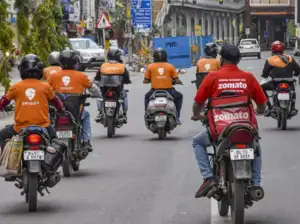
India’s food delivery platform sector has emerged as a major engine of job creation and economic growth, employing nearly 1.37 million workers in 2023–24 and growing at a strong 12.3% compound annual growth rate (CAGR) over the past two years, according to a new study by the National Council of Applied Economic Research (NCAER).
The report, titled Impact of Food Delivery Platform Sector on India’s Economy, highlights how digital food delivery platforms have rapidly expanded their footprint, outpacing overall employment growth in the country. Employment in the sector rose from 1.08 million workers in 2021–22 to 1.37 million in 2023–24, accounting for nearly 0.2% of India’s total workforce. This growth significantly exceeds the all-India employment CAGR of 7.9%, underlining the sector’s rising importance in the labour market.
Backbone of India’s Growing Gig Economy
Placing the findings within the wider gig economy landscape, the study draws on NITI Aayog estimates, which show India had 7.7 million gig workers in 2020–21, a figure projected to surge to 23.5 million by 2029–30. Food delivery platforms are expected to remain among the largest contributors to this expanding workforce, alongside ride-hailing, logistics, and other platform-based services.
The report notes that food delivery has become a critical entry point for flexible employment, particularly for youth and migrant workers, offering income opportunities with relatively low barriers to entry.
Mapping the Full Economic Value Chain
A key strength of the NCAER study lies in its comprehensive mapping of the entire food delivery ecosystem—from platform development and payment systems to restaurants, cloud kitchens, delivery partners, and last-mile logistics. By doing so, the report seeks to establish food delivery as a distinct economic sector, an area currently underrepresented in official statistics.
This ecosystem-based approach helps quantify the sector’s real contribution to output, employment, value addition, and tax revenues, providing a clearer picture of its macroeconomic impact.
Strong Multiplier Effects Across the Economy
The findings reveal that food delivery platforms generate strong multiplier effects, ranking seventh among all sectors in terms of output multiplier. This means that growth in food delivery triggers significant indirect economic activity across allied industries such as packaging, logistics, technology services, and hospitality.
In terms of employment, the sector has the second-highest employment multiplier within services, second only to hotels and restaurants. This indicates that expansion in food delivery not only creates direct jobs but also fuels employment across connected sectors.
The report estimates a tax multiplier of 0.04, implying that every Rs 10 lakh of output generated in 2021–22 resulted in about Rs 40,000 in indirect tax revenue, reflecting the sector’s increasing fiscal contribution.

Output and GVA Nearly Double in Two Years
NCAER estimates show that the gross value of output (GVO) of food delivery platforms almost doubled from ₹61,271 crore in 2021–22 to nearly ₹1.2 lakh crore in 2023–24. Consequently, the sector’s share in national output rose from 0.14% to 0.21% during this period.
Indirect taxes now account for 4.7% of the sector’s gross value added (GVA)—nearly twice the share seen in many traditional sectors—highlighting higher levels of formalisation and digital compliance.
Shifting Consumption Patterns and Policy Challenges
The report attributes the sector’s rapid growth to changing urban consumption habits, deeper smartphone penetration, widespread adoption of digital payments, and time-constrained lifestyles. However, it also stresses the need for focused policy interventions, particularly around worker welfare, social security for gig workers, and long-term sustainability of platform-led growth.
As food delivery platforms continue expanding into smaller cities and towns, NCAER concludes that the sector is set to play a pivotal role in employment generation, tax mobilisation, and services-led economic growth in the coming decade.