What began as modest experiments in college dorm rooms, rented garages, and cramped offices has today evolved into some of the most powerful companies in human history. Google, Apple, Facebook, Amazon, Microsoft, YouTube, WhatsApp, and Spotify were not born out of billion-dollar boardrooms—but out of curiosity, courage, and a refusal to accept the status quo.
These companies now shape how billions of people communicate, shop, learn, work, and entertain themselves every single day. Yet, at the heart of each success story lies a simple truth: one idea, seen earlier than the rest of the world, can change everything.
Seeing the Future Before It Arrived
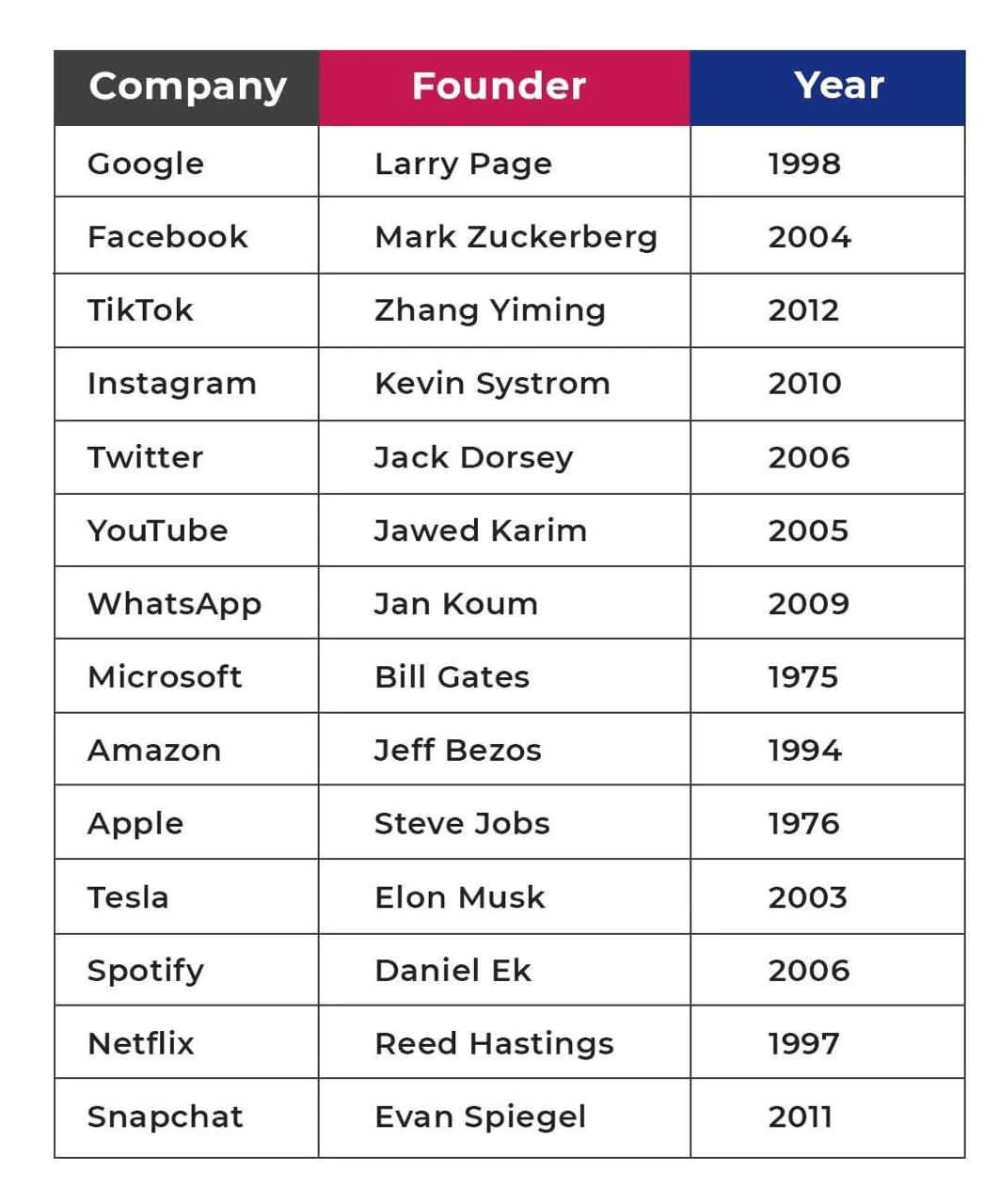
In 1998, two PhD students—Larry Page and Sergey Brin—built Google in a Stanford dorm room, believing the internet needed better organization. At a time when search engines were chaotic and unreliable, Google quietly became the gateway to the world’s information.
In 2004, Mark Zuckerberg, then a Harvard student, launched Facebook from his hostel room—not to build a global empire, but to connect classmates. Today, it has reshaped human interaction, politics, marketing, and media on a planetary scale.
Similarly, Jawed Karim and his co-founders launched YouTube in 2005 with a simple goal: make video sharing easier. That idea went on to create the creator economy, turning ordinary people into global stars and redefining entertainment forever.
The Rise of Digital Commerce and Personal Technology
Back in 1994, Jeff Bezos started Amazon as a small online bookstore from his garage. His vision went far beyond selling books—he wanted to build “the everything store.” Today, Amazon dominates e-commerce, cloud computing, logistics, and artificial intelligence.
Even earlier, in 1976, Steve Jobs co-founded Apple in a garage, blending technology with design, creativity, and emotion. Apple didn’t just make devices—it created a culture around innovation, turning phones, computers, and wearables into lifestyle symbols.
Meanwhile, Bill Gates, who launched Microsoft in 1975, foresaw a world where every home would have a personal computer. His software laid the foundation for modern workplaces, education systems, and digital productivity.
The Mobile-First Generation of Innovators
As technology evolved, a new wave of founders adapted to changing user behavior. Evan Spiegel launched Snapchat in 2011, understanding that younger audiences valued privacy, impermanence, and visual storytelling.
In 2012, Zhang Yiming introduced TikTok, leveraging artificial intelligence to personalize content in ways no platform had done before. Within a decade, TikTok reshaped global pop culture, music, marketing, and attention spans.
Similarly, Daniel Ek, who founded Spotify in 2006, reimagined how the world consumes music—making streaming, not ownership, the future.
More Than Companies—They Built Ecosystems
These founders didn’t just create successful startups; they built entire digital ecosystems—generating millions of jobs, empowering creators, redefining education, and connecting cultures across borders.
Their journeys prove that age, background, and resources matter less than vision, timing, and persistence. Many were doubted, dismissed, or underestimated—but their belief in their ideas outlasted every obstacle.
A Lesson for the Next Generation
From garages to global empires, these stories remind us that the next world-changing idea may already exist in a notebook, dorm room, or small office somewhere today.
In a digital age driven by innovation, one strong idea—backed by courage and consistency—still has the power to influence billions of lives across generations.