
Gurugram is witnessing a major shift in its real estate landscape.
In one of the sharpest revisions in recent years, the Haryana government has increased circle rates — the minimum property valuation used for stamp duty and registration — by 15% to as high as 75% across different areas, fundamentally altering the cost dynamics for buyers and investors.
The new rates have come into effect from April 1, 2026, and are already sending ripples across the NCR property market.
Where the Biggest Shock Lies: Premium Corridors See 75% Spike
The steepest hikes are not uniform — they are concentrated in Gurugram’s fastest-growing corridors.
Areas like Dwarka Expressway and Southern Peripheral Road (SPR) have recorded maximum increases of up to 75%, reflecting their rapid infrastructure growth and rising demand.
Even established zones are seeing significant jumps. For instance, residential rates in Sector 15 are expected to rise by around 45%, while some commercial areas like Sector 25 may witness hikes touching 75%.
This clearly signals a market correction where government rates are being aligned closer to actual market prices.
What Circle Rate Hike Means: Direct Impact on Buyers’ Pocket
For homebuyers, the impact is immediate and unavoidable.
Higher circle rates mean higher stamp duty and registration charges, making property transactions more expensive. Even if the market price remains unchanged, buyers will now have to pay taxes based on the revised, higher benchmark.
In simple terms — buying property in Gurugram has just become significantly costlier.
At the same time, sellers and investors may benefit, as higher official valuations strengthen property worth and improve long-term returns.
Why Government Increased Circle Rates
The move is not random — it reflects a larger structural shift.
For years, Gurugram’s market prices had surged far ahead of government-set circle rates, creating a mismatch. The 2026 revision aims to bridge this gap, increase transparency, and boost government revenue from property transactions.
Experts also believe that the revision acknowledges Gurugram’s status as one of India’s most premium real estate destinations, driven by corporate presence, infrastructure expansion, and proximity to Delhi.
Real Estate Market Reaction: Pressure + Opportunity
The immediate reaction is mixed.
On one hand, buyers may delay purchases due to increased costs. On the other, investors see this as a strong signal of long-term appreciation and market maturity.
Developers are likely to recalibrate pricing strategies, while premium locations may continue to attract high-value investments despite higher entry costs.
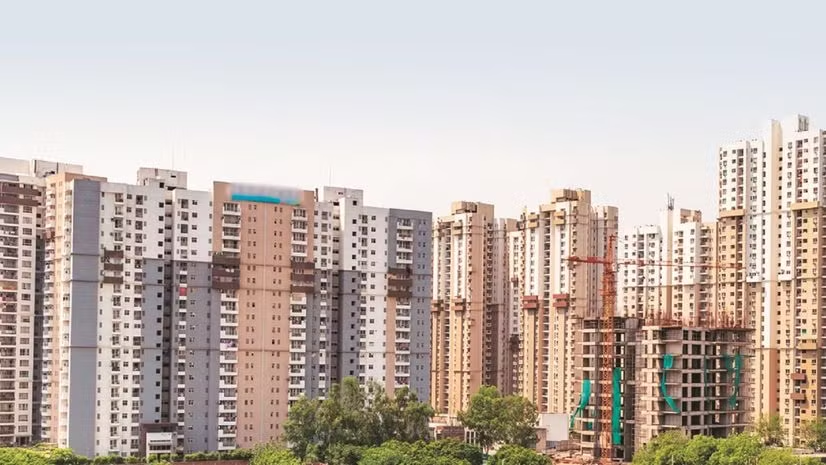
Bigger Picture: NCR Property Market Enters New Phase
This development is not just about Gurugram — it reflects a broader transformation in NCR’s real estate ecosystem.
With infrastructure projects like expressways, metro expansion, and growing corporate hubs, cities like Gurugram are moving toward global-standard pricing structures.
The circle rate hike essentially confirms one thing — Gurugram is no longer an emerging market. It is a fully matured, high-value real estate zone.
What Buyers Should Watch Now
With prices rising and government benchmarks catching up, timing becomes crucial.
Those planning to invest must now carefully evaluate location, future growth potential, and total transaction cost — because the margin for “cheap deals” is rapidly shrinking.