

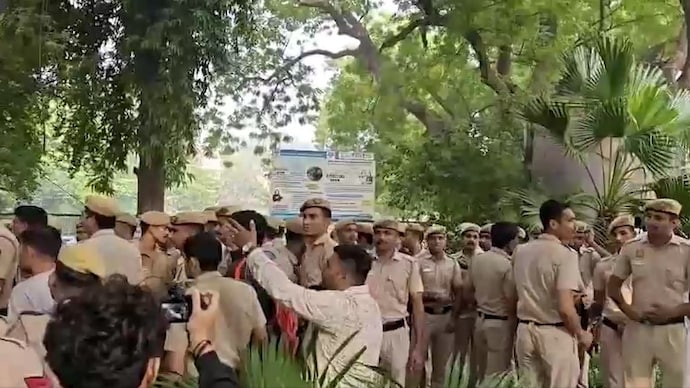
Around 100 Delhi Police personnel staged a protest outside the Delhi Police Headquarters on Monday, opposing an administrative decision by senior officers to transfer an Assistant Commissioner of Police and a Station House Officer following a confrontation with advocates. The demonstration took place near Gate No. 1, where personnel gathered to raise slogans such as “Police Ekta Zindabad,” terming the administrative action one-sided and damaging to force morale. The transferred ACP also arrived at the site to join the demonstration. The protesting officers demanded the immediate reinstatement of both officers to their prior postings, an audience with the Police Commissioner, and the establishment of a formal Standard Operating Procedure to handle conflicts involving police officers and legal practitioners.
Origins of the Shahdara Police Station Confrontation
The dispute traces back to an October 23 altercation between police personnel and lawyers inside Shahdara police station, during which an advocate reportedly sustained serious head injuries. In the aftermath of the incident, lawyers launched a strike and demanded strict action against ACP Manasvi Vashishth, alleging that he brandished his service firearm during the confrontation. In response to mounting pressure, the Delhi Police administration issued transfer orders for ACP Vashishth, who was then assigned to the Gandhi Nagar subdivision, alongside Shahdara SHO Inspector Arun Kumar. The administrative decision caused widespread resentment among ranks within the force, who contended that the leadership had yielded to pressure from advocates rather than conducting an impartial investigation. The protesting personnel maintained that decisions of this nature should not be determined exclusively by demands made by one faction.
Senior Leadership Intervenes as ACP Urges Dialogue
Following the assembly outside the headquarters, senior police officials arrived at the scene in an attempt to dissuade the demonstrators from continuing their roadside protest. The Deputy Commissioner of Police (New Delhi) urged the personnel to avoid blocking public streets and appealed to them to uphold the discipline expected of a uniformed force. The DCP advised the demonstrators to take their grievances inside the building and seek an audience with the Police Commissioner. Although initial appeals were met with continued slogan-shouting, officials gradually initiated formal discussions to guide the personnel indoors for deliberations. Separately, ACP Vashishth issued a video statement expressing gratitude to the colleagues who offered him support, remarking that the incident had not weakened his resolve. He discouraged personnel from assembling on public streets and requested that the Police Commissioner convene a comprehensive dialogue. ACP Vashishth proposed that this session include wide representation from the force, utilizing video conferencing for personnel unable to attend in person, to thoroughly examine the events of October 23 and the negotiations that ensued.
Demands for Reinstatement and Institutional Frameworks
The core demand put forward by the protesting personnel remains the reinstatement of both ACP Vashishth and Inspector Kumar to their former assignments. The personnel argued that an impartial review of the October 23 incident is essential to safeguard the confidence of the force. Furthermore, the personnel called for the formal adoption of a Standard Operating Procedure designed to resolve future disputes between police officers and lawyers. The demonstrators asserted that establishing transparent institutional protocols would prevent arbitrary or one-sided disciplinary measures whenever similar conflicts occur. The demonstration drew significant public interest, marking a rare occurrence of serving police personnel publicly questioning decisions implemented by their own administrative establishment. Senior officers have initiated formal discussions with the protesting personnel to address the raised issues, and subsequent steps will depend on the findings of these consultations and the administration’s official response to the demands.

