

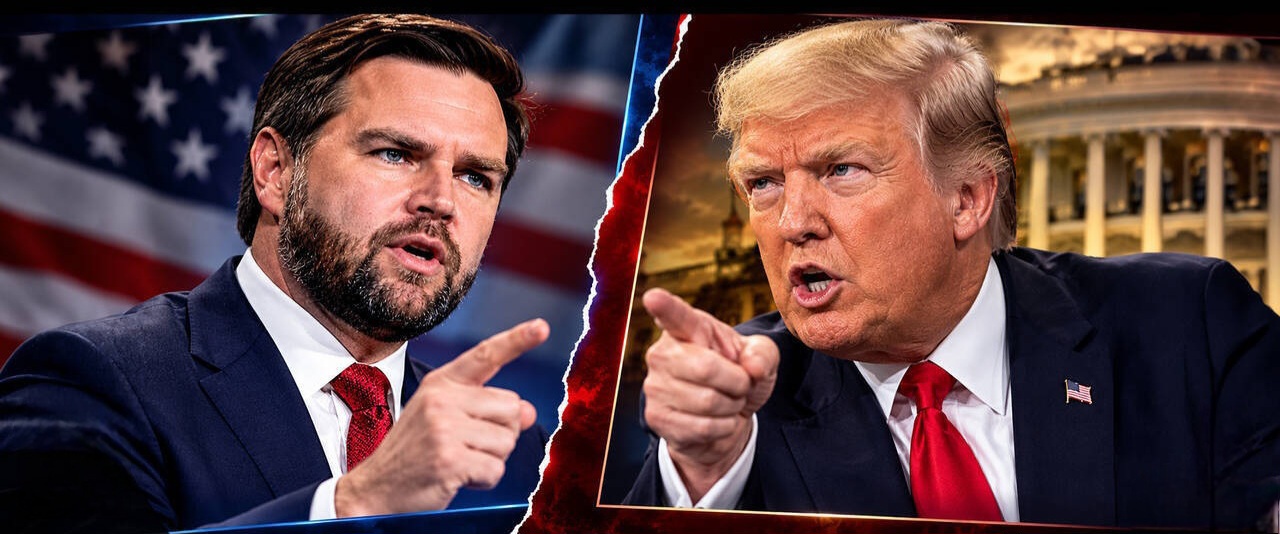
NEW YORK — U.S. President Donald Trump has removed Vice President JD Vance from ongoing peace talks and diplomatic initiatives with Iran, signaling a sharp shift in the administration’s foreign policy. Trump stated clearly that the United States no longer needs any agreement or deal with Tehran, bringing an abrupt halt to backchannel negotiations Vance had been preparing.
In a message posted on social media, Trump declared that the days of needing a deal with Iran are far behind. He asserted that the U.S. holds hundreds of billions of dollars belonging to Iran and maintains control over the Strait of Hormuz. The announcement came shortly after a Wall Street Journal report revealed that Vance was drafting a framework for direct talks and a new round of peace negotiations with a senior Iranian official.
The policy shift follows significant losses for the Republican Party in recent midterm elections, which weakened its position in both the Senate and the House. Following the election results, Vance publicly stated that a prolonged conflict with Iran was a major reason behind the party’s defeat. Political analysts suggest that these internal disagreements and Vance’s public remarks prompted Trump to alter the administration’s strategic direction.
Vance Reassigned to Domestic Oversight
After sidelining Vance from the Iran portfolio, Trump assigned him a new domestic mandate. The president ordered Vance to focus his full attention on investigating alleged corruption and crime in states and cities governed by the Democratic Party.
Trump specifically named major Democratic-led states such as California, Minnesota, and Illinois, alleging widespread financial irregularities and misuse of public funds. Analysts view this move as an effort by the Republican leadership to adopt an aggressive domestic posture, aiming to gain political leverage by targeting financial transparency and administrative accountability in opposition strongholds.
Halted Diplomatic Efforts and Strait of Hormuz Tensions
Trump had initially tasked Vance with leading negotiations with Iran earlier this year, despite the vice president’s known reservations about the war. In April, Vance traveled to Pakistan and held several hours of talks with Iranian leaders, though those discussions ended without an agreement. More recently, Vance attempted to revive dialogue by sending a letter through Qatar to senior Iranian leader Mohsen Rezaei, proposing an immediate meeting between officials from both nations that Vance offered to lead. Trump’s latest directive has effectively terminated those outreach efforts.
Meanwhile, although major military strikes between the United States and Iran have paused, bilateral tensions remain high. Friction persists over control of the Strait of Hormuz, one of the world’s most critical oil transit routes. The U.S. continues to enforce a naval blockade to restrict Iranian oil exports, while American warships patrol the waters to ensure the safe passage of oil tankers belonging to other nations.
U.S. Navy Quietly Dismisses Three Senior Commanders
In Washington, members of Congress have expressed strong dissatisfaction over the U.S. Navy’s quiet removal of three senior commanders and officials in recent months. Last month, the Navy dismissed the entire leadership team of the nuclear-powered attack submarine USS South Dakota, including its commander, second-in-command, and senior enlisted leader.
Additionally, Commander Kaitlin Cunningham of the destroyer USS Michael Murphy, which has been deployed for operations against Iran, was relieved of her duties. Rear Admiral Dr. Brian Monahan, the attending physician to Congress and the Supreme Court, was also quietly removed from his post. Separately, the U.S. military announced that its forces intercepted and destroyed two suicide drones launched by Iran toward Bahrain.

