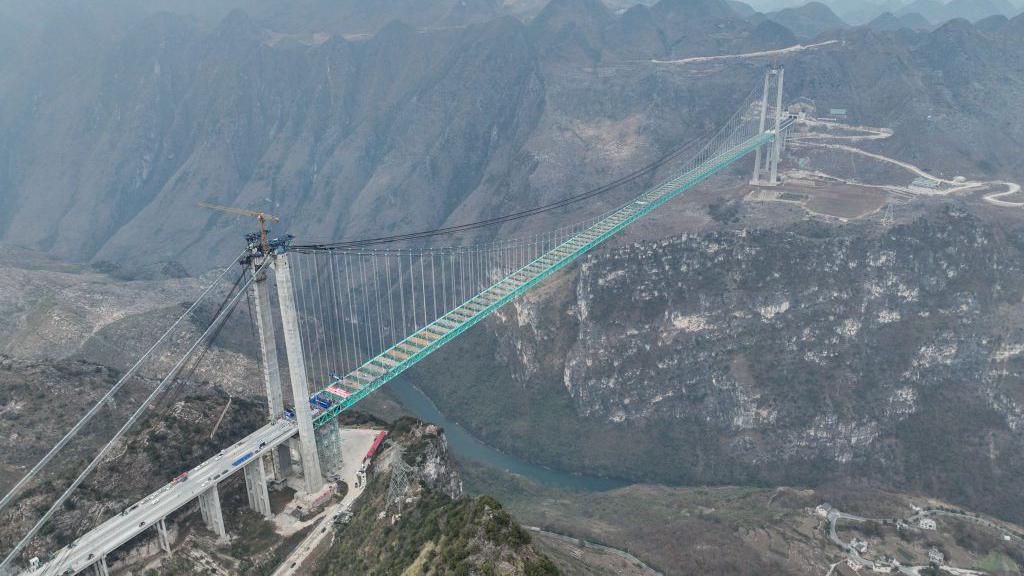
China, a nation that has long embraced the drama of building at the edge of the possible, is preparing to open a bridge so tall it dwarfs nearly every man-made structure on earth.
Later this month, the Huajiang Grand Canyon Bridge will carry its first cars across the jagged cliffs of Guizhou Province, spanning a gorge more than 2,000 feet deep — almost two Eiffel Towers stacked end to end.
For residents of this mountainous corner of southwest China, the bridge is more than a headline-grabbing marvel of engineering. It turns what was once a tortuous one-hour detour down switchback roads and across ferries into a two-minute dash across four lanes of tarmac. For Beijing, it is a showpiece of infrastructure ambition: a reminder that even in regions historically cut off from China’s growth, concrete and steel can bind the country together.
A Vertical Feat of Engineering
Stretching nearly 1.8 miles, with a main span of 1,420 meters, the Huajiang Bridge towers 625 meters (2,050 feet) above the Beipan River — higher than San Francisco’s Golden Gate Bridge stacked atop the Empire State Building. Engineers say the suspension structure has endured months of wind-resistance and load tests, including a recent five-day trial, confirming its readiness for traffic.
China already dominates the record books for dizzying bridges; eight of the world’s ten highest road crossings are within its borders. But even against this backdrop, the Huajiang Bridge stands apart, designed not only to slash travel times but to showcase the technical sophistication of Chinese builders.
Beyond Concrete: Symbol of a Strategy
The bridge is part of the Liuzhi-Anlong Expressway, a project meant to open up the rural southwest. Officials argue that reducing isolation is critical to spurring local economies and stemming migration out of Guizhou, one of China’s less developed provinces.
But the project also speaks to something larger. Infrastructure remains a cornerstone of China’s governance model, used both to deliver visible improvements to citizens’ lives and to signal global leadership in engineering might. Just as its high-speed rail network became a symbol of modernization, the Huajiang Bridge may now be cast as a metaphor: that no canyon, however deep, is beyond the reach of the state.
Looking Down — and Ahead
The opening is expected later this month, drawing tourists, engineers, and a fair measure of national pride. Yet, as with other megaprojects, questions linger — about maintenance in one of the country’s most challenging terrains, about environmental cost, and about whether such colossal investments can pay for themselves in the long run.
For now, though, the bridge stands as a breathtaking statement. In Guizhou’s misty hills, where until recently narrow dirt roads were the only lifeline, drivers will soon glide across a span that seems to float in the clouds — a steel ribbon stretched between the mountains, twice as tall as the Eiffel Tower and entirely of this century’s making.