

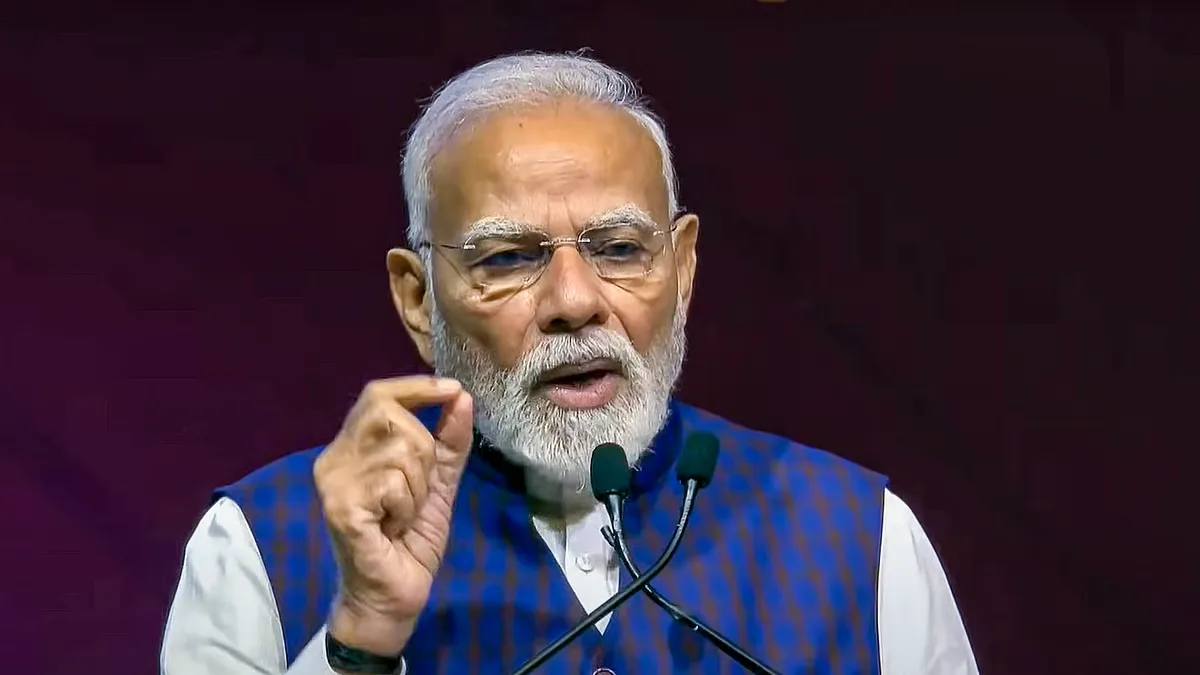
Prime Minister Narendra Modi has challenged Indian industry leaders to demonstrate how they have used corporate tax cuts, income tax relief and other government reforms to benefit employees and strengthen the economy. Addressing the FICCI Annual General Meeting and Annual Convention in New Delhi on November 19, Modi asked companies whether they had increased wages, generated employment and invested in new areas of growth.
The Prime Minister stressed that economic development could not remain the government’s responsibility alone. While the government had introduced reforms to improve the business environment, industry needed to take greater responsibility for creating jobs, improving product quality and reducing India’s dependence on imports.
He also urged businesses to make better use of India’s expanding network of free trade agreements (FTAs), identify emerging global opportunities and contribute to the country’s ambition of becoming a developed nation by 2047.
Modi Asks Companies to Deliver on Tax Benefits and Reforms
During his address, Modi pointed out that the government had reduced corporate tax rates, provided income tax relief, simplified compliance requirements and signed trade agreements to create better opportunities for Indian businesses.
However, he questioned whether companies had translated these benefits into higher employee incomes and increased employment.
The Prime Minister indicated that businesses should assess their contribution beyond profits and expansion, focusing equally on job creation and workers’ financial well-being. He called on industry leaders to explain what they had done to support employees after receiving the benefits of government reforms.
Modi also encouraged companies to develop specific strategies to benefit from India’s growing network of trade agreements. Rather than waiting for the government to identify business opportunities, companies should actively explore new markets, understand international demand and strengthen their export capabilities.
Indian Consumers Deserve the Same Quality as Global Buyers
The Prime Minister cautioned businesses against treating India’s large domestic market as an assured source of demand. With a population of approximately 140 crore, India offers companies a substantial consumer base, but that should not become a reason to compromise on quality.
“My countrymen deserve quality goods,” Modi said, emphasising that Indian consumers should receive products of the same standard as those marketed in international markets.
He questioned the practice of presenting certain products as being of export quality, suggesting that quality standards should remain consistently high across domestic and overseas markets.
The message was aimed at encouraging Indian manufacturers to improve product quality, strengthen brand credibility and compete more effectively in international markets.
FCRF Launches Certified Chief Risk Officer (CRO) Program for India’s Risk Leaders
Import Substitution and New Manufacturing Opportunities
Modi called for greater investment in domestic manufacturing, particularly in industries where India continues to depend on imports despite having access to raw materials, established manufacturing capabilities or a strong domestic market.
He highlighted the pharmaceutical sector as an important example. Although India is widely recognised as a major global supplier of medicines, it still imports significant quantities of active pharmaceutical ingredients (APIs), bulk drugs and intermediates.
The Prime Minister urged companies to identify products that could be manufactured competitively within the country and invest in the technologies required to reduce import dependence.
He also referred to aluminium and steel, pointing out that India has substantial natural resources but continues to rely on imports for certain specialised products.
Agriculture and food processing were other areas where he identified considerable potential. Despite India’s large agricultural production base, its share of global agricultural exports remains around 2–2.5 percent. Modi encouraged businesses to invest in food processing, value addition and products tailored to international consumer demand.
He also identified engineering goods, hand tools, power tools, packaging equipment and irrigation machinery as promising sectors, particularly for expanding exports to developing economies and countries across the Global South.
Strong Growth Outlook, but Industry Must Look Ahead
Modi’s remarks came amid improving growth expectations for the Indian economy and strong merchandise export performance. He noted that international institutions, including the Asian Development Bank and Moody’s, had revised their growth expectations for India, with projections increasingly pointing towards growth of 7 percent or more.
India’s merchandise exports reached a record $49.47 billion in October, registering a 45.1 percent increase compared with the corresponding period a year earlier.
However, the Prime Minister cautioned businesses against focusing only on sectors that offer immediate returns. He urged industry leaders to anticipate changes in domestic and international demand over the next two decades and prepare accordingly.
Referring to the global trend of resources being increasingly used as strategic instruments, Modi called for an India-first approach that strengthens domestic capabilities while creating opportunities in international markets.
He also assured industry representatives that the government remained open to further reforms and invited suggestions on policy changes that could improve competitiveness.
The Prime Minister emphasised that achieving the Viksit Bharat vision would require a long-term commitment from both the government and the private sector. He urged companies to look beyond short-term business targets and consider what they could contribute to India’s development over the next decade.

