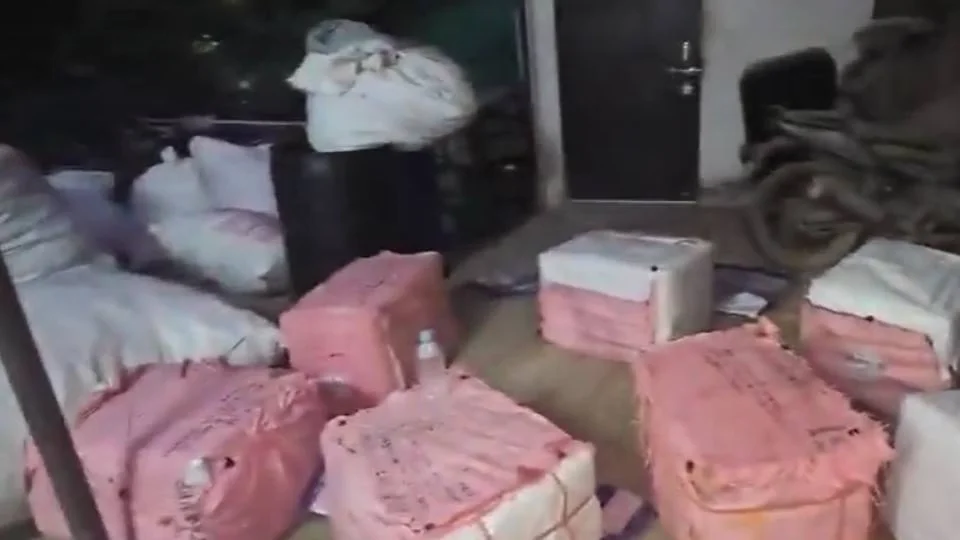
An illegal manufacturing unit allegedly producing counterfeit solutions in the name of restricted oxytocin has been uncovered in the Dubagga area of Lucknow. A joint team of the Food Safety and Drug Administration (FSDA) and the Uttar Pradesh Special Task Force (STF) arrested two people during a late-night raid on Monday.
According to officials, the unit was allegedly using phenyl, salt and a suspicious powder to prepare a solution marketed as oxytocin. The team seized finished products, liquid, ampoules, bottles and packaging material collectively valued at approximately Rs 2.05 crore.
The scale of the recovery, including a large number of filled containers and packaging supplies, has raised suspicions that the operation was designed for large-scale production and distribution.
More Than 1.77 Lakh Ampoules and 3,700 Bottles Seized
During the raid, officials recovered 3,700 bottles of 200 ml each and 1,77,800 ampoules of 2 ml each. Around 35 litres of liquid labelled or described as oxytocin were also seized.
The team also found machinery used for packaging and sealing the products, along with a substantial quantity of empty containers and packaging accessories.
The recovered material included 8,000 empty bottles, 48,000 aluminium caps and 5,000 rubber caps. Sealing machines were also found at the premises.
Investigators suspect that the packaging arrangements were intended to prepare the products for distribution through an organised supply network. However, the actual composition of the seized substances and the extent of their production will need to be established through laboratory examination.
Phenyl, Salt and Suspicious Powder Found at the Factory
The joint team recovered 12 containers of phenyl, 36 kilograms of salt and an unidentified powder from the premises.
Preliminary suspicion is that these materials were being mixed to prepare a solution falsely represented as oxytocin. However, officials will be able to establish the precise chemical composition and the quantities used only after laboratory testing.
Investigators are also examining the manufacturing process, the source of the raw materials and the machinery used to prepare and package the products.
The presence of large quantities of empty bottles, aluminium caps and rubber closures has strengthened suspicions that the facility was equipped not merely for preparing the liquid but also for packaging it in a manner suitable for commercial distribution.
FCRF Launches Certified Chief Risk Officer (CRO) Program for India’s Risk Leaders
Two Arrested; Agencies Investigate Supply Network
The FSDA and STF arrested two suspects during the operation. Officials have estimated the value of the seized material at approximately Rs 2.05 crore.
The investigation has now expanded to identify the suppliers of raw materials, the people involved in manufacturing and the channels through which the finished products were intended to be sold.
Authorities are also examining the labels used on the bottles and ampoules and trying to establish which distributors, customers or markets were being targeted.
The recovery has raised concerns that counterfeit products may already have reached the market. However, there is currently no confirmed information establishing that the seized products had been sold or supplied to consumers. Further investigation and questioning of the arrested suspects are expected to reveal the scale of the operation.
Counterfeit Oxytocin Raises Serious Public Health Concerns
Oxytocin is a hormone used in specific medical situations under professional supervision. Unregulated or inappropriate use can pose serious health risks. The sale of a counterfeit product under its name is particularly concerning because its ingredients, concentration, quality and effects may be unknown.
If a solution prepared using unverified chemicals reaches patients or animals, it could cause harm. Such products can also expose consumers to financial losses and undermine confidence in medicine distribution and quality-control systems.
The alleged use of phenyl, salt and unidentified powder in a solution being marketed as oxytocin has raised questions about the monitoring of illegal drug manufacturing and distribution.
Following the arrests, the FSDA and STF are expected to question the suspects to identify other people involved and establish how long the unit had been operating. Investigators are also tracing the sources of raw materials and examining the intended distribution channels.
Laboratory analysis of the seized samples and further questioning will be crucial in determining the actual nature of the products and the extent of the alleged counterfeit manufacturing network.