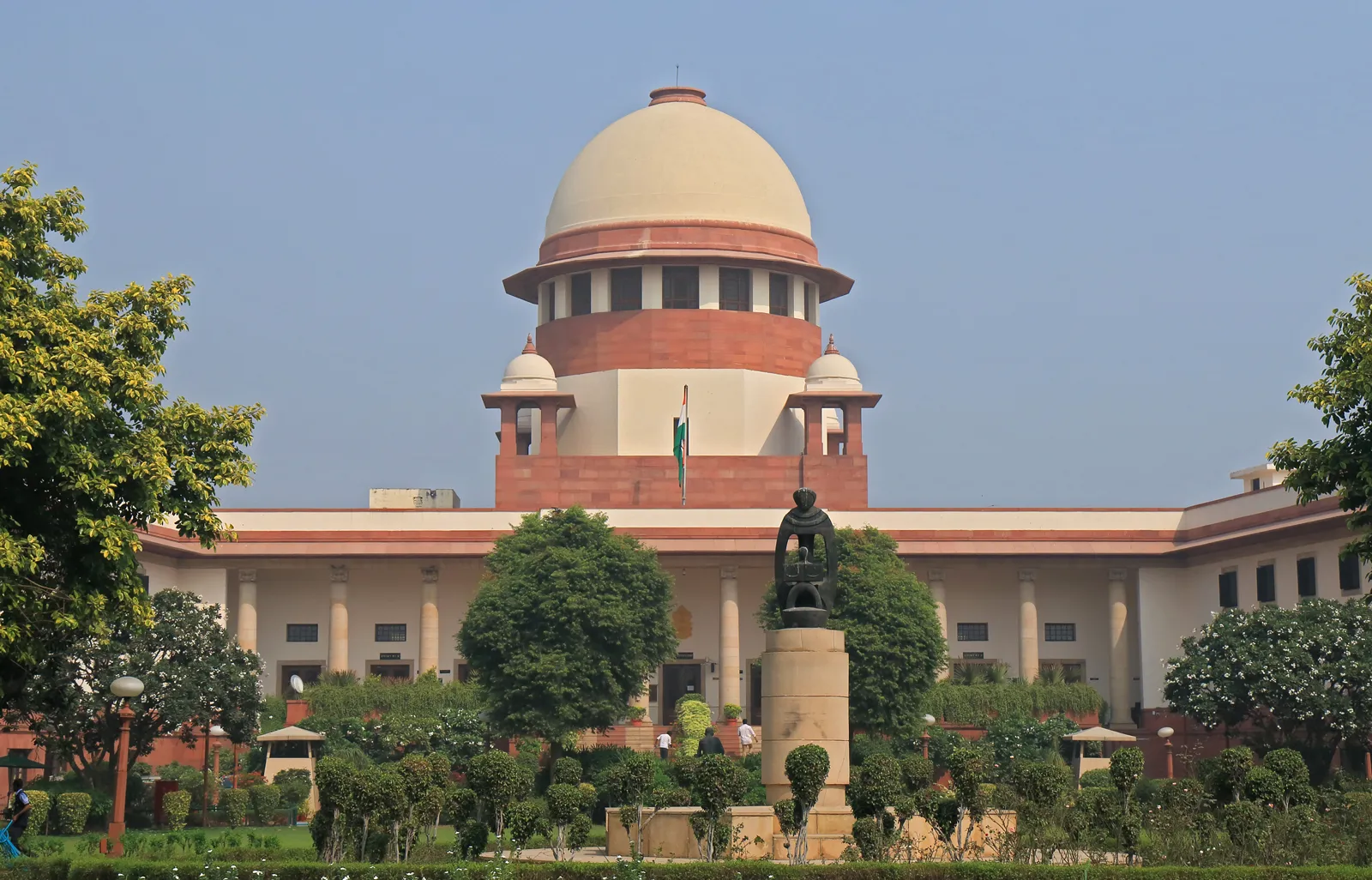
The Supreme Court has strongly questioned the judicial powers exercised by a sessions judge in Bihar who allegedly summoned a Superintendent of Police (SP), held him guilty and imposed a fine on the same day after a police order to register an FIR was not followed. Expressing serious concern over the manner in which judicial authority was exercised, the apex court asked under what legal provision the judge could directly convict and punish a police officer without following the prescribed procedure.
During the hearing, the bench comprising Chief Justice of India Surya Kant and Justice Joymalya Bagchi made strong observations about the judicial officer’s conduct. Justice Bagchi reportedly described the judge’s understanding of the law as disappointing and cautioned against behaving like a ‘Bahubali’ while exercising judicial powers. The court emphasised that judicial authority must remain within the limits established by law.
SP Summoned and Punished Over Non-Registration of FIR
The matter originated when a sessions judge in Bihar directed the police to register an FIR in a particular case. However, the concerned police authorities allegedly failed to comply with the direction. Following this, the judicial officer treated the non-compliance as an offence committed in the court’s presence.
The SP was subsequently summoned before the court and allegedly held guilty on the same day, with a monetary penalty imposed against him. This action raised questions about whether a sessions judge could directly summon senior district officials, treat their failure to comply with an earlier judicial direction as an immediate offence and impose punishment without following the applicable legal procedure.
The Supreme Court questioned the legal basis for such an approach and asked the counsel representing the judicial officer to advise his client against adopting an unnecessarily aggressive attitude. The bench stressed that judicial officers must understand the distinction between disobedience of a court order and an offence committed in the immediate presence of the court.
Supreme Court Explains BNSS Section 384 and CrPC Section 345
During the proceedings, Justice Joymalya Bagchi referred to Section 384 of the Bharatiya Nagarik Suraksha Sanhita (BNSS) and the corresponding provision under the earlier Code of Criminal Procedure (CrPC), Section 345.
These provisions deal with certain offences committed in the presence of a court and provide a limited mechanism for immediate judicial action. However, the authority is subject to specific legal conditions and cannot be exercised arbitrarily.
The bench clarified that the provision is intended for situations where an offence takes place during judicial proceedings or directly in the presence of the judge and interferes with the administration of justice. Merely failing to comply with an earlier court direction does not automatically qualify as an offence that can be punished immediately under these provisions.
FCRF Launches Certified Chief Risk Officer (CRO) Program for India’s Risk Leaders
Slapping or Abusing Someone in Court Can Invite Immediate Action
To explain the scope of these provisions, the Supreme Court referred to examples of conduct that may justify immediate action by a court. These include physically assaulting someone inside the courtroom, using abusive language during proceedings or refusing to leave the courtroom despite a clear direction from the judge.
Such acts occur in the court’s immediate presence and can disrupt judicial proceedings. In these circumstances, the law provides a limited power to take prompt action to maintain courtroom discipline and protect the dignity of judicial proceedings.
However, the bench made it clear that this power cannot be extended to every instance of disobedience of a judicial order.
Separate Legal Procedure Required for Disobedience of Court Orders
The Supreme Court highlighted that when a police officer or government official fails to comply with an order issued outside the immediate proceedings of a courtroom, the matter must be addressed through the appropriate legal mechanism.
A failure to follow a judicial direction may raise serious legal questions, but it does not automatically authorise a judge to convict and punish the concerned official on the same day. The court must follow the procedure prescribed under the applicable law.
The apex court’s observations underline the importance of judicial restraint, procedural fairness and clearly defined limits on judicial powers. The proceedings also highlight the distinction between offences committed in the presence of a court and alleged disobedience of judicial directions.
The Supreme Court’s intervention reinforces the principle that judicial authority, regardless of the position held by an officer, must be exercised strictly within the framework of law.