

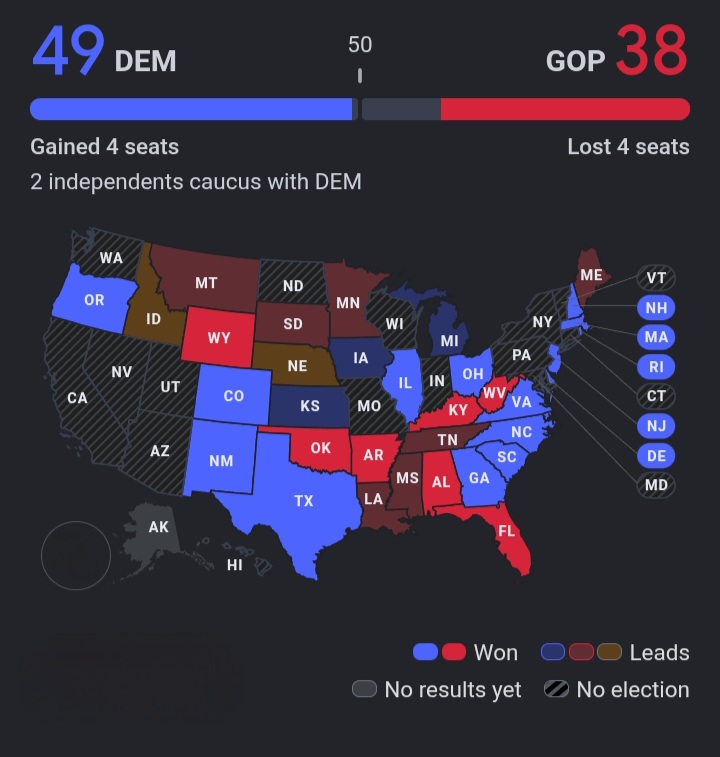
NEW DELHI — Early results from the 2026 United States midterm elections have dealt an unexpected blow to President Donald Trump and the Republican Party, as the Democratic Party surged toward a majority in the House of Representatives and established a lead in the Senate. Facing mounting pressure as early returns came in, President Trump delivered his first reaction to the emerging numbers, asserting that the outcome would have looked entirely different had his own name been on the ballot. Speaking on the initial trends, Trump maintained that his absence from the race directly shaped the outcome, stating that he was not a candidate on the ballot this time and insisting that had he been running, his party would have secured a massive majority victory. He also offered thanks to the public for keeping their attention focused on him during the unfolding political contest.
Democrats Surge Toward House Majority as Senate Leads Narrow Republican Hopes
The substantial gains recorded by Democratic contenders across the House of Representatives represent a pivotal challenge for the Trump administration. Initial returns reveal that Democratic candidates have outpaced their Republican rivals in multiple key constituencies, securing confirmed victories in several seats and steadily closing in on the threshold required to command a legislative majority. Parallel returns from the Senate indicate an equally difficult path for Republicans, with Democratic contenders holding active leads over their counterparts. A dual loss of control across both chambers of Congress would place immediate strain on the administration, as legislative initiatives, key appointments, and policy maneuvers face the prospect of sustained opposition oversight. While observers emphasize that preliminary trends remain subject to change as complete tallies are certified, the opening margins have injected deep apprehension into Republican campaign headquarters.
Crucial Constitutional Milestone for Legislative and Policy Agendas
The midterm elections occur at the exact midpoint of a president’s four-year term, serving as a comprehensive national verdict on the sitting government’s direction. With all seats in the House of Representatives and approximately one-third of the Senate seats contested, these races determine the balance of power within the legislative branch. When the governing party preserves its governing majorities across both chambers, administrations typically find it far simpler to introduce bills, secure essential appropriations, and advance contentious policy priorities without protracted legislative compromise. Conversely, should the opposition capture either chamber, the presidency confronts severe institutional hurdles, complex budgetary negotiations, and intensified scrutiny over executive actions, fundamentally constraining the administration’s ability to govern by decree or rely on party unity.
Shift in Capitol Hill Power Balance Presents Fresh Political Test
The Democratic Party’s current momentum signals a probable reordering of political power in Washington, one likely to force significant adjustments upon the administration’s policy trajectory and governing playbook. Securing one or both chambers grants the opposition party considerable authority to stall executive branch measures, challenge cabinet priorities, and shape the national discourse heading into subsequent election cycles. While President Trump sought to deflect the electoral damage by framing the results around his personal popularity and electoral drawing power, the stark reality of the opening vote counts confirms that the Republican Party faces an arduous institutional climate. The narrowing path to a governing majority in both the House and the Senate leaves the White House confronting a fundamentally altered political landscape that will define the remaining years of the presidential term.

